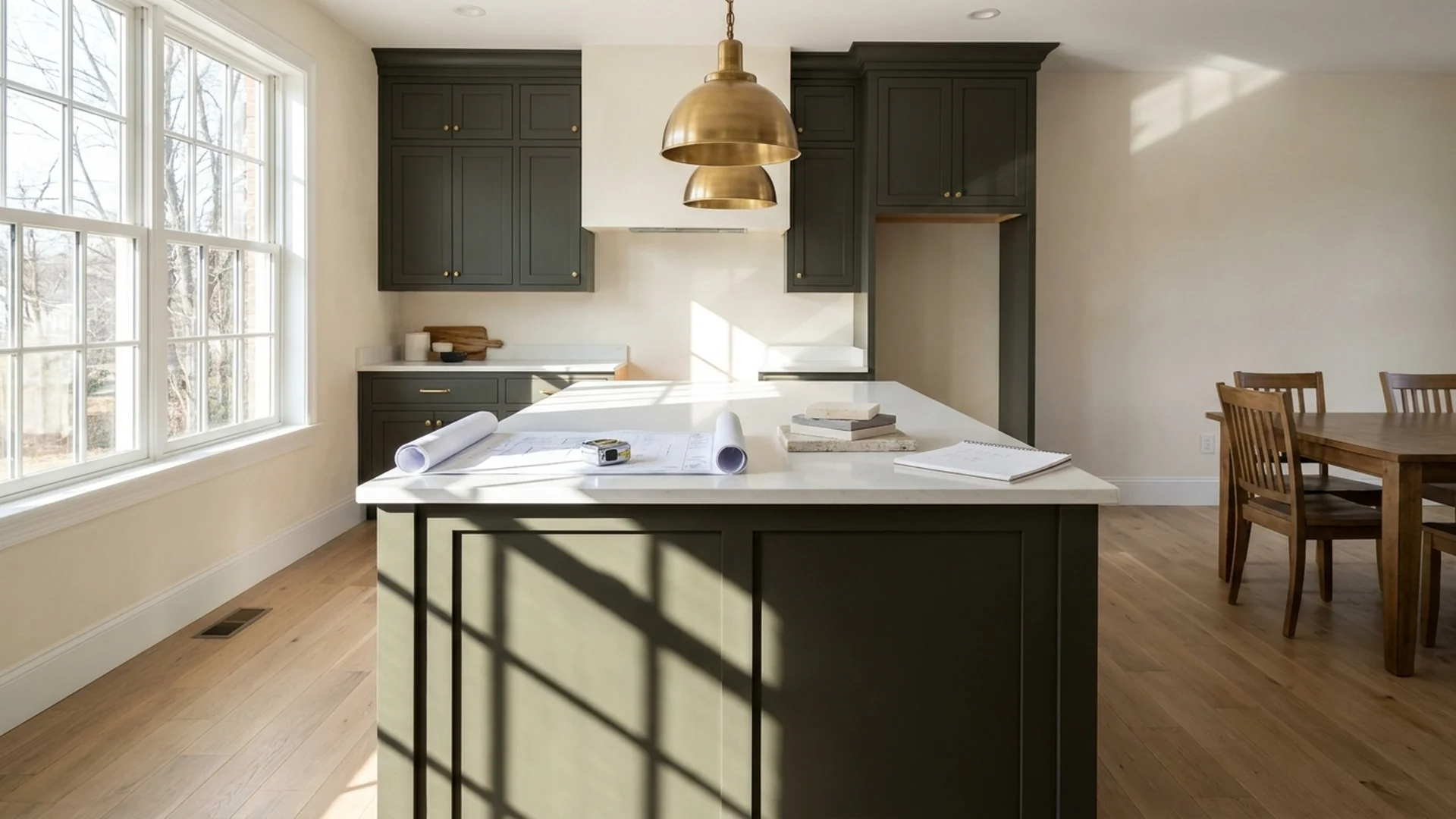
The 30% rule usually means one thing: a remodel budget should not exceed about 30% of the home’s current value. A $400,000 DFW home caps around $120,000. But the same phrase gets used for two other things: how much a contractor may ask for up front, and how big a contingency should be. Those are different numbers. Confusing them is what costs people money.
All three are real rules of thumb. They are simply not the same rule, and the one that protects your money before you sign is not the one people usually quote.
Your remodel budget should not exceed about 30% of the home’s current value.
This is the one people mean. On a $400,000 Plano home that caps a kitchen near $120,000. It is a resale guardrail, not a law. It exists because value recovery is capped by what the neighbourhood supports. Spend past the ceiling and the extra rarely comes back on resale; it buys you the years you live in it instead, which is a legitimate reason to exceed it as long as you are choosing it deliberately.
A contractor asking for more than 30% before work starts is a red flag.
Money should follow progress, not precede it. A large up-front demand moves the contractor’s risk onto you and leaves nothing holding the schedule. UHS takes a deposit of 10–20%, scaled to the size of the project (well under the red-flag line), and the rest is billed against progress milestones, with a final payment held until your walkthrough. That last payment is the one that matters: if nothing is held back, nothing is holding the punch list.
Contingency is 10–20%, not 30%.
A contingency is money set aside for what the walls hide: old wiring, a failed drain line, rot under a shower pan. It is not the same pot as the budget cap and it is not 30%. Budgeting a 30% contingency usually means the scope was never priced properly; budgeting none means the first surprise becomes a change order you cannot absorb. There is more on sizing one in our DFW renovation cost guide.
Take the home’s current market value, not what you paid for it. The cap is a ceiling, not a price. The right-hand column sets it against what the work actually costs, using the ranges we publish for remodeling across Dallas–Fort Worth, and the pattern worth noticing is that for single-room work the cap almost never binds. It starts to matter on whole-home scopes and additions.
| Home value | 30% cap | What the work actually costs |
|---|---|---|
| $300,000 | ~$90,000 | A bathroom runs $8,000–$60,000, well inside the cap |
| $400,000 | ~$120,000 | A kitchen runs $25,000–$95,000, still inside it |
| $600,000 | ~$180,000 | Kitchen and bathrooms together, comfortably |
| $900,000 | ~$270,000 | Whole-home runs $95,000–$350,000: here the cap starts to bind |
| $1,200,000 | ~$360,000 | The full whole-home range fits |
These caps are a guardrail, not a quote. Scope, structure and finish level move the real number far more than the cap does. A load-bearing wall or a slab penetration will reshape a budget that the table says is comfortable. For a scope-specific range rather than a ceiling, the cost calculator works from your rooms and finish level, and the whole-home page breaks the larger scopes into tiers.
Not because anyone is trying to catch you out. Because four sentences reliably cost homeowners money, and all four are easy to replace.
It reads as an open budget and it removes your only lever. Give a range instead. A real contractor will tell you what fits inside it and what does not, which is the conversation you actually want.
Two prices are only comparable if the scopes are. Ask for both as line items. Most gaps between DFW bids are not margin, they are things one bid left out: permits, disposal, the electrical the inspector will require anyway.
It sounds relaxed and it costs you sequencing. Crews schedule around firm dates; a job with no date gets the gaps between jobs that do.
The most expensive silence. Say who signs off, what your deadline is, and what would make you say no. A contractor who cannot work with that has told you something useful.

“When a homeowner sends me another DFW contractor’s agreement to compare, the first line I look for is the final payment. If nothing is held until the walkthrough, nothing is making the punch list happen, and that tells me more than the deposit figure does.”
The deposit is 10–20%, scaled to the size of the project. Everything after it is billed against progress rather than the calendar, and a final payment is held until your walkthrough. That last one is the part worth checking in any contract you are handed, because it is what keeps the punch list moving. The same structure applies whether it is one bathroom or a whole-home renovation.
Work is covered by a written one-year workmanship warranty from substantial completion. The terms are set out on the warranty page, and the sequence a project actually follows is on how we work.
The 30% rule says a remodel budget should not exceed about 30% of the home’s current value. On a $400,000 Dallas–Fort Worth home that caps a project around $120,000. It is a resale guardrail rather than a law: value recovery is limited by what the neighbourhood supports, so spending past the ceiling rarely returns on resale.
It applies to the total project, not to one room. UHS Remodeling publishes kitchens at $25,000–$95,000, bathrooms at $8,000–$60,000 and whole-home renovations at $95,000–$350,000, so most single-room work in DFW sits well inside the cap. The rule starts to bind on whole-home scopes and on additions.
It depends on the scope, not on the number. In Dallas–Fort Worth, $100,000 covers a full kitchen or a partial whole-home refresh; a complete whole-home renovation runs $95,000–$350,000 depending on size and finish level. Under the 30% rule, $100,000 also implies a home worth roughly $330,000 or more.
Anything over 30% before work begins is a red flag. UHS Remodeling takes a deposit of 10–20%, scaled to the size of the project, and bills the balance against progress milestones with a final payment held until your walkthrough.
They are different pots of money. The 30% rule caps the total budget against the home’s value. A contingency is money reserved inside that budget for what the walls hide, and it runs 10–20% of project cost, not 30%.
Avoid “whatever it costs”, which removes your only lever, and avoid quoting a rival’s price without its scope, since two bids are only comparable as line items. Do say who signs off, what your deadline is, and what would make you say no.
That depends on the contract, so read the one you are signing. UHS Remodeling gives a written one-year workmanship warranty running from substantial completion, with visible defects reported within 7 days of discovery and every claim answered within 48 business hours.
Your contractor should. In Texas permits are issued city by city, and the firm doing the work is the one that pulls them and meets the inspector. UHS Remodeling pulls and manages permits on every project where the scope requires one.
Tell us the rooms and the range you have in mind. The first consultation is free, takes about an hour, and you get an honest budget before you commit to anything.