
Move or remodel in DFW, worked through at three budgets
Selling and buying costs 7–11% of your house before you improve a single room. Here is that number set against three real remodel budgets, including the one where moving is the right answer.
Most homeowners arrive at this decision with a remodel budget in mind and no number at all on the other side of the ledger. That is backwards. Moving has a price too, it is largely fixed, and it is a percentage of your house rather than a percentage of your project, which means it barely moves when your ambitions do. Our DFW home remodeling overview already publishes that percentage and the per-square-foot comparison behind it. What follows does the thing a framework cannot: it runs the same arithmetic three times, at three different budgets, and follows each one through to an actual recommendation. One of the three ends with us telling you to sell.
Move or remodel in Dallas–Fort Worth
Selling and buying carries 7–11% in friction (realtor commissions of about 5–6% plus closing costs of about 2–5%) and new-home square footage prices at $150–$300 per square foot against roughly $100 to remodel space you already own. That arithmetic favors remodeling for dated finishes ($40K–$95K) and for layout changes ($85K–$200K for an open-concept conversion). It stops favoring it at gut-to-the-studs scope, published at $200K–$350K+ over 6–12 months: when roof, foundation and systems are all at end of life and the plan is still wrong, moving wins.
The two numbers this turns on
The comparison most people make is a remodel quote against a listing price. That is the wrong pairing, because a listing price is not a cost; you get most of it back. The right pairing is the cost of acquiring the space you want, computed both ways.
Going one way, that cost is the friction of selling and buying, plus whatever the extra square footage prices at in a new house. Going the other, it is a construction contract on square footage you already own, and no friction at all. Both are published numbers on this site. Neither of them is a mortgage rate, which is why rates are absent from everything below: they change weekly, and they change your monthly payment rather than the size of either number.
A note on what this post is not. The framework itself (commissions, closing costs, per-square-foot new versus remodeled) is already laid out on the remodeling overview, and the scope bands are already on the whole home remodeling page. This is the worked version. Read those first if you want the definitions.
What it costs to move
Our remodeling overview publishes the components: realtor commissions of roughly 5–6%, closing costs of roughly 2–5%, and moving expenses on top. Netted out, that is 7–11% of your sale price in sell-and-buy friction. It buys you nothing physical. It is the toll for changing houses.
The important property of that number is that it scales with your house, not with your plans. A homeowner considering a $60,000 kitchen and a homeowner considering a $300,000 gut pay exactly the same toll to move out of the same house. So the first thing to do is size it.
What leaving costs before a single improvement is bought.
What leaving costs before a single improvement is bought.
What leaving costs before a single improvement is bought.
What leaving costs before a single improvement is bought.
Those rows are arithmetic on the published 7–11%, not a claim about what any particular DFW house is worth. Take the row nearest your own number and carry it through the three scenarios below.
Then there is the space itself. The overview prices new-home square footage at roughly $150–$300 per square foot against roughly $100 per square foot to remodel space you already own. Moving pays the friction and then buys the space at the higher of those two rates.

“When a DFW homeowner asks me whether to move or remodel, I ask what they would change if money were not the issue, then whether the roof and the slab would let us do it. If the second answer is no, I would rather say so at the first walkthrough than after the walls are open.”
What it costs to remodel instead
The whole home remodeling page carries nine scopes, from a cosmetic refresh at $40K–$95K through a full whole-home renovation at $95K–$250K to a gut-to-the-studs at $200K–$350K+. It also gives the per-square-foot equivalents and the timeline for each. There is no point repeating that table here. What matters for this decision is that you choose which row you are on. The friction number was chosen for you.
Size matters less than most people expect, but it is not nothing. Our DFW remodel cost guide publishes whole-home renovation by house size: a 2,000 sq ft home runs $95,000–$145,000 at a standard finish and $145,000–$220,000 mid-range, while a 2,500 sq ft home runs $120,000–$180,000 and $180,000–$275,000 respectively. The 2026 DFW remodeling cost study sorts the same money by ambition instead: Essential $95K–$160K, Refined $160K–$240K, Custom $240K–$350K+.
Three scenarios follow. Each one fixes a budget, applies the friction table, and ends with a recommendation.
Not sure which of these applies to your house? A short conversation settles it faster than any calculator.
Scenario one, dated finishes and sound bones
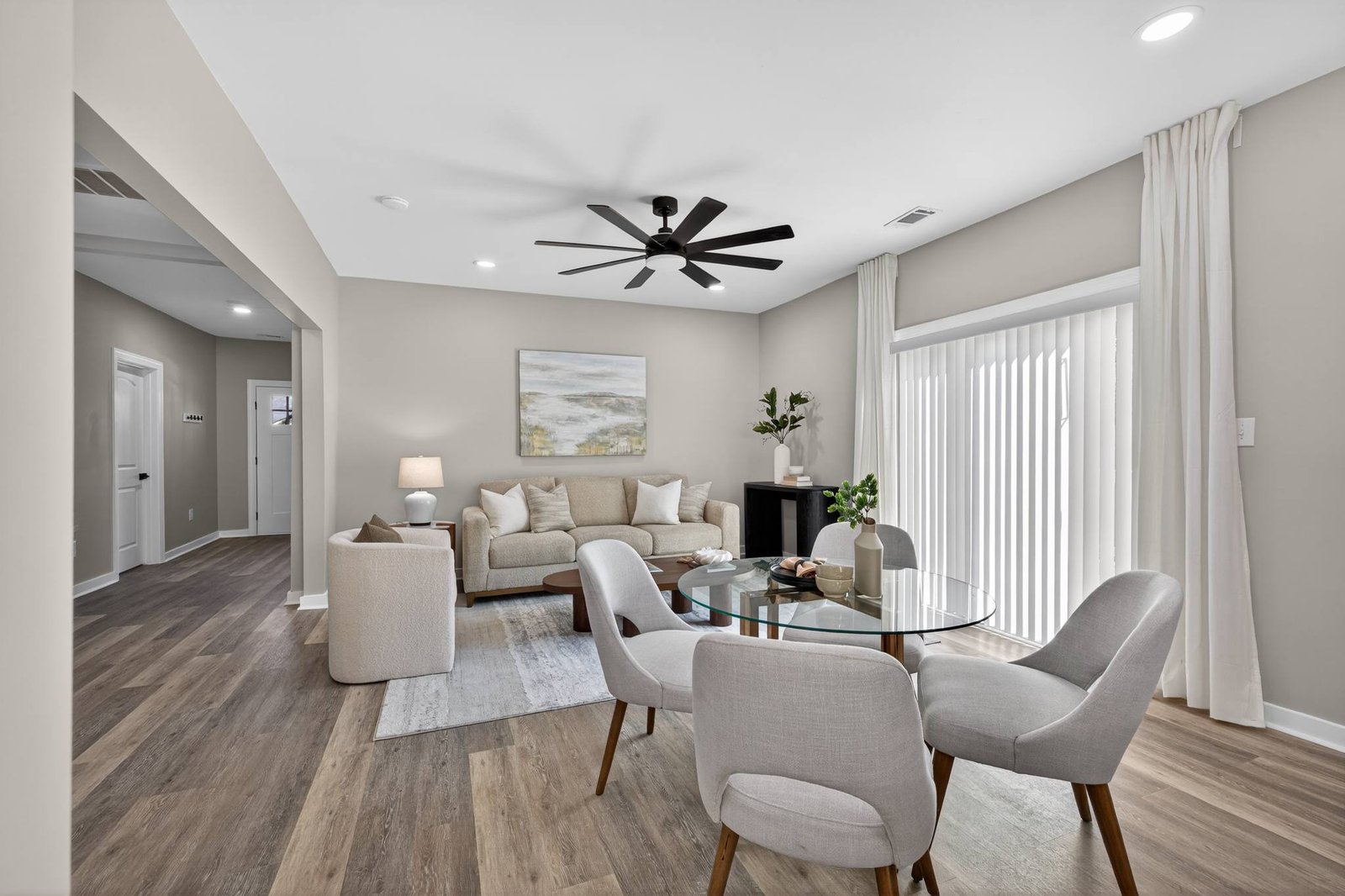
A 2,000 sq ft house. The floor plan works, the systems are fine, the roof is not a problem. It simply looks like the decade it was built in, and the kitchen is closed off from everything.
The published options are the cosmetic refresh band at $40K–$95K, the kitchen, bath and flooring package at $55K–$110K, or a standard 2,000 sq ft whole-home renovation at $95,000–$145,000. Call it $60,000 to $145,000 depending on how far you take it.
Now the other column. On a $600,000 sale, friction alone is $42,000–$66,000. That figure is roughly the entire cost of the three-zone package, and it delivers no new kitchen, no new baths and no new floors. It delivers a moving truck. Then you buy replacement square footage at $150–$300 per foot instead of improving yours at about $100.
There is a resale argument pointing the same way. Our cost study reports that minor kitchen remodels recoup more than they cost, and puts a midrange bathroom at 67–73% in the Dallas region. Those are the two rooms this scenario is about.
Remodel, and probably not the whole house. The narrow, high-return scope usually beats the full refresh here. Construction on a cosmetic-led project runs 2–4 months.
Scenario two, the layout is the problem
Same house, different complaint. The finishes are survivable but the plan is wrong: a kitchen walled off from the living room, no real primary suite, a single bath serving three bedrooms. This is where the decision genuinely tightens.
The published numbers are larger. An open-concept conversion (removing a load-bearing wall and carrying the load on a new steel or LVL beam) runs $85K–$200K. A full whole-home renovation runs $95K–$250K. A 2,500 sq ft mid-range renovation runs $180,000–$275,000.
Set $200,000 against $42,000–$66,000 of friction and moving looks cheaper. It is, on friction. But friction is not the whole cost of moving, because the layout you want does not come free with the new address. You pay for it in the purchase price, at $150–$300 per square foot for anything larger or better than what you have, and you pay the friction on top.
The tie-breaker is structural, not financial. Our renovate, remodel or rebuild guide publishes the test as three questions: do you like the layout, can the existing structure support the layout you want, and would fixing it cost more than about 60–70% of a rebuild. If the answer to the middle question is yes, the beam is engineerable and the walls can move, then you are buying a new floor plan for construction money instead of buying a new house for construction money plus friction plus a purchase premium.
Be honest about resale while you do it. The same cost study puts additions and whole-home renovations at roughly 45–55% recouped. A layout remodel is something you do to live in the house, not to break even on it.
Remodel if the structure can carry the plan and you would buy this location again today. If you would not buy the location again, stop: you are about to spend six figures fixing the wrong variable.
Scenario three, where moving wins
Now the case we are not supposed to write. The roof is at end of life, there is foundation movement, the branch wiring is aluminum, the drains are cast iron and corroding, and the floor plan is still wrong after all of it.
Those are not taste problems. As the whole home remodeling page explains, defects like these run through every wall and ceiling, so replacing them means opening the entire envelope, which puts you in gut-to-the-studs territory at $200K–$350K+ and 6–12 months of construction. Our renovate-versus-rebuild guide prices a DFW tear-down rebuild on your existing lot from around $250,000 to well past $500,000 over 8–16 months, and sets the switch-over point at a remodel costing 60–70% or more of that rebuild.
Run the ledger. A $250,000 gut on a house you would sell for $600,000 is roughly four times the top of the friction band, and at the end of it you still own the same lot, the same schools and the same commute. Moving costs $42,000–$66,000 of friction plus the price difference between the two houses, and it is the only option on the table that changes location as well as layout.
Our remodeling overview states the counter-case plainly: when the home needs roof, foundation and full systems and still does not fit your life, a whole-home overhaul can exceed $200K and moving may win. The whole home remodeling page draws the same line from the other side, noting that a teardown often makes sense once renovation approaches about half the structure’s value.
Move. We would rather say that at the consultation than have you discover it three weeks into demolition.
We will walk your house, tell you what is actually possible on your lot, and put a fixed price on it. No charge, and no obligation to build with us.
Or read the numbers first: the whole home remodeling page.
The costs neither column shows
Four line items decide more of these comparisons than the headline numbers do.
Temporary housing
Every published UHS range excludes it, and the whole home remodeling page sets out how much of the house goes out of service during a gut. Over 6–12 months that is a second rent, and it belongs in the remodel column.
Contingency
The cost study recommends 10–15% on top of the contract for what older houses hide. Add it before you compare, not after.
The clock before the clock
DFW city permits typically run 3–6 weeks, and HOA architectural review commonly adds 2–6 weeks on top. Design, budgeting and permitting all happen before demolition day.
Where you are
Trade labor in Frisco and Plano runs 8–12% above Garland or Rowlett, and affluent communities carry a documented 10–20% premium. That raises your remodel cost. And friction, being a percentage, rises with the sale price in those same markets.
One last constraint applies to both columns: do not improve past what the block can carry. Spending rebuild money on a house in a neighborhood that will not price it back is the most expensive version of this mistake, and it is available in either direction.
Run it on your own house
Three inputs settle it. First, your realistic sale price multiplied by 7–11%: that is what leaving costs before you buy anything. Second, the published band for the scope you actually need, which is the row you get to choose. Third, whether the existing structure can carry the plan you want, which is the only one of the three a spreadsheet cannot answer.
For the second input, our remodeling cost calculator works inside those same published bands and shows every one of them openly, so you can locate yourself before you talk to anyone. For the third, the scopes and the structural triggers are set out on the whole home remodeling page, and a walkthrough turns the band into a fixed price.
If the arithmetic points at the moving truck, we will say so. That answer costs us a project and saves you a year.
Questions we get
What percentage of my sale price goes to selling and buying in DFW?
Roughly 7–11% in total friction. Our DFW remodeling overview breaks that into realtor commissions of about 5–6% and closing costs of about 2–5%, with moving expenses on top. On a $600,000 sale that is $42,000 to $66,000, and none of it buys physical improvement. Because it is a percentage of your house rather than your project, the figure is identical whether you were planning a $60,000 remodel or a $300,000 one.
At what point does moving actually become cheaper than remodeling?
When the work crosses into gut territory and the house still will not fit your life. A gut-to-the-studs renovation is published at $200K–$350K+ over 6–12 months, and our renovate-versus-rebuild guide flags the switch-over once a remodel would cost 60–70% or more of a full rebuild. Against 7–11% friction, that is a clear loss for remodeling, particularly if the location is wrong as well.
Is it cheaper to add square footage or to buy a bigger house?
It depends whether you are improving space or creating it. Remodeling square footage you already own runs about $100 per square foot, well under the $150–$300 per square foot our overview quotes for new-home space. But building new square footage also runs $150–$300 per square foot, with additions published at $120K–$400K+, so an addition does not carry the same advantage. The saving comes from reusing space, not adding it.
What if I would not buy my house again today?
Then stop before you price the remodel. Every calculation in this post assumes the location, lot and schools are worth keeping. That assumption is what turns avoided sell-and-buy friction into a real saving. If you would not choose the address again, a remodel fixes the house and leaves the actual problem in place, and the 7–11% you would spend leaving is buying you something. Location is the one input here that construction cannot change.
How long am I displaced if I remodel instead of moving?
Long enough that it belongs in the budget, not just the schedule. The whole home remodeling page publishes the construction window for each scope, and design, budgeting and permitting all run before that clock starts. What neither column shows is the housing bill: temporary housing is excluded from every published UHS range, so on a gut you pay for somewhere else to live while you still own this house. Price it alongside the contract before you compare.
Does the DFW city I live in change the answer?
It moves both columns at once. Our cost study puts trade labor in Frisco and Plano at 8–12% over Garland or Rowlett, with a documented 10–20% premium in affluent communities, so building costs more in those markets. But friction is a percentage of a higher sale price in exactly the same places, so it rises in step. The city rarely flips the decision; it mostly enlarges whichever number was already winning.
Moving costs 7–11% of your sale price before you have bought anything, and that number is the one people leave out of the comparison. Remodeling costs a published band you get to choose from. The only input a spreadsheet cannot supply is whether the structure can carry the plan you want, and that is a walkthrough, not a calculation.
Related from the journal
Get the remodel number before you call a realtor.
Fully insured · 500+ verified five-star reviews · fixed-price contracts · 1-year workmanship warranty.
Prefer to talk? (469) 850-7087 · or use the contact page.