
The 2027 Cabinet Tariff: What It Means for a DFW Kitchen or Bath
A scheduled step from 25% to 50% on imported kitchen cabinets and vanities lands on New Year’s Day, unless it is delayed again. It reaches one or two lines of a kitchen or bath budget, and a doubled duty is not a doubled price.
If your 2027 plans include new kitchen cabinets or a new vanity, one line of your budget has a date on it. If you are refinishing the cabinets you already have, that date does not reach them.
The US duty on imported kitchen cabinets and vanities is scheduled to rise from 25% to 50% on January 1, 2027, under Proclamation 10976 as amended on December 31, 2025.
It has been delayed once already. The step touches the cabinet and vanity lines, not labor, counters or tile. Ask where yours are made and when your price locks.
What is scheduled for January 1, 2027
Section 232 is the national-security trade law, and these proclamations apply it to wood products. The December proclamation says the one-year delay “will result in more productive negotiations of agreements,” and the 50% rate excepts “countries with which the United States reaches an agreement.” Which countries end up excepted can change before January, so we do not list them here.
We last checked the Federal Register for a newer proclamation on November 19, 2026. If the date moves again or the rate changes, we will update this post.
What the duty touches in a kitchen or bath budget
A remodel estimate is a stack of lines: demolition, plumbing, electrical, cabinets, countertops, tile, flooring, fixtures and labor. This duty lands on two of them, the cabinets and the vanity, and only when they or their parts are imported. Our DFW kitchen cost guide shows where cabinets sit among the other lines.
Not sure which of these applies to your house? A short conversation settles it faster than any calculator.
Why a 50% duty does not mean a 50% higher kitchen
The proclamation sets the duty “ad valorem,” a percentage of the cabinet’s value when it enters the country. It is not a percentage of your installed price. Between the port and your kitchen sit freight, the distributor, the dealer, installation and every other line in the estimate.
So the step from 25% to 50% does not add 25% to your remodel. How much of it reaches you depends on the cabinet’s import value, the markups along the way, and how much each seller absorbs.
The date that sets the rate is the customs date. The proclamation charges its duty on goods “entered for consumption,” the customs term for goods cleared into the US, and the 50% rate is scheduled from January 1, 2027. Cabinets that cleared customs before then are not charged the January rate. Whether a seller prices that stock at the old rate is the seller’s call.
US-made is not a price freeze either. Nationally, producer prices for particleboard and fiberboard, sheet goods used in many cabinet boxes, were up 13.9% year on year in October 2026, according to NAHB’s analysis of the producer price index. And we found no published 2027 cabinet price forecast for DFW, so we will not invent one.
The cabinet’s value when it enters the country. Freight, markups, installation and the rest of your estimate come on top.
Five questions to ask before you sign
Where are the cabinets and the vanity made?
Ask for the country of origin on the quote or the spec sheet, for the boxes and for the doors. If the answer is “it depends on the line,” ask which line your estimate prices. On our jobs, the cabinets and vanities we supply are domestic, not imported, so this duty is not added to them directly. Any parts imported for use in them can still carry the duty.
How long is this estimate valid?
An estimate prices a scope at the supplier costs of the day it was written. Its validity period is how long that price holds if you sign. If an estimate written in December is signed in February, ask whether the cabinet and vanity lines were re-quoted.
What does the contract lock, and is there a price-escalation clause?
If there is one, ask what triggers it, how much notice you get, and whether you can cancel if it does. If there is none, ask what happens when a supplier raises a price before delivery.
When is the order placed, and when do the cabinets arrive?
For imported cabinets, the rate follows the customs date, not the order date. Ask whether yours are already in US stock or will be imported after January 1.
What does a change order cover?
Switching a cabinet line, a finish or the vanity after you sign is a change order. On our jobs, no change goes ahead until you approve its scope and price in writing. Ask for the same rule wherever you sign.
Your options if the cabinet line worries you
- Keep the boxes and refinish them. If the boxes are sound and the layout works, refinishing buys no new cabinets, and the budget goes into counters, the sink and hardware.
- Reface. New doors and drawer fronts go on the boxes you already have. Doors can count as cabinet parts, so ask where they are made.
- A US-made stock or semi-custom line. Semi-custom means standard sizes with limited modifications. Get the origin in writing, and expect domestic lines to carry their own material costs.
- Custom, shop-built cabinetry. It is built to your room, which takes longer, so the order goes in earlier in the schedule. Ask where it is built rather than assume.
- The vanity. In a bath, the vanity is one line among tile, glass, plumbing and labor. On our Plano bathroom remodeling page, the vanity moves with the tier, from semi-custom to fully custom. At any tier, ask where it is made.
For kitchens, our page on kitchen remodeling in Dallas lays out what each tier includes, from same-layout kitchens with semi-custom cabinetry to shop-built custom cabinetry.
Tell us what you are planning. We will walk your house, tell you what is actually possible, and put a real number on it before you commit to anything.
Or read the numbers first: kitchen remodeling in Dallas.
What we see on DFW jobs
Three of our own jobs show where the cabinet and vanity lines sit.
Garland: the kitchen that kept its cabinets. On a whole-house refresh in Garland, the kitchen kept its layout and its cabinet boxes. We refinished the doors, drawer fronts, face frames and exposed bases, and measured the new quartz on site, over the cabinets that stayed. No new cabinets were bought, so a cabinet duty had nothing to land on.
Plano: who buys what. On a Plano master bath we finished in August 2026, the custom vanity cabinets were in our contract. The tile, the tub, the plumbing and light fixtures and the hardware were not: the homeowners picked and paid for those themselves. Our crew needed four weeks on site, and the calendar ran longer while those finishes were being chosen and bought. In a tariff year, that split decides when each price is set. A finish you buy yourself is priced on the day you buy it. A line inside the contract follows the contract’s terms.
North Dallas: the long-lead line. A North Dallas kitchen we remodeled has fully custom walnut cabinetry, each box, door and drawer made to that room’s measurements. On kitchens of that kind, our case study lists custom cabinet lead times next to stone fabrication and appliance delivery as what drives the schedule. Whatever line you choose, pin down when the cabinets are ordered and, for an imported line, when it clears customs.
Settle the cabinets and the vanity before demolition. In a tariff year, that line can move the budget as well as the schedule.
Should you sign before January 1?
Sign when the design is right, not to beat a date. The January date has already moved once.
Rushing the design
Cabinets ordered before the layout is settled can come back as a change order.
Reading “ordered in December” as “priced at 25%”
The rate follows the customs date. Your price follows your contract.
Accepting a line that just says “cabinets”
Without a brand, a line and an origin, it cannot tell you what this duty does to it.
At UHS, the first visit is free, takes about an hour, and needs no deposit. The 3D design is free and comes before you sign, and each estimate gives one price for the agreed scope. Bring the five questions above.
Questions we get
Are kitchen cabinets going up in price in 2027?
Imported ones may. The Section 232 duty on imported kitchen cabinets and vanities is scheduled to rise from 25% to 50% on January 1, 2027, unless it is delayed again or the country of origin reaches an agreement with the US. US-made cabinets are outside this duty, but their materials are rising too: particleboard and fiberboard producer prices were up 13.9% year on year in October 2026, nationally, according to NAHB. We found no published 2027 cabinet price forecast for DFW.
When does the 50% tariff on kitchen cabinets start?
It is scheduled for January 1, 2027. Proclamation 10976 of September 29, 2025 first set the step for January 1, 2026, and Proclamation 11000 of December 31, 2025 moved it back a year, citing ongoing negotiations. The new rate applies to cabinets entered at US customs on or after that date, so the customs date, not your order date, decides which rate a shipment pays.
Does the cabinet tariff apply to bathroom vanities?
Yes. The proclamation names kitchen cabinets and vanities together, along with parts imported for use in them, so an imported vanity is scheduled for the same step from 25% to 50%. A faucet or a mirror bought separately is outside this duty, though other tariffs can apply to some fixtures. Ask where the vanity is made and whether its price already reflects the January rate.
Are cabinets made in the USA affected by the tariff?
Not directly, because the duty applies to imports. Two caveats: parts imported for use in cabinets and vanities are covered, so a cabinet assembled in the US from imported doors or components can carry part of the duty; and domestic material costs are moving on their own. Ask for the country of origin of the boxes and the doors in writing.
Should I buy kitchen cabinets before the tariff goes up?
Only if your design is final. The rate follows the date imported cabinets clear US customs, not the date you sign or order, and the step has been delayed once already. If the layout changes after the order goes in, the cabinets change with it, and that is a change order. If you are planning a 2027 kitchen, settle the cabinet and vanity selections first, then ask when your price locks.
Will the cabinet tariff change my remodel estimate?
That depends on what your estimate locks and for how long. Ask how long it is valid, whether the contract has a price-escalation clause and what triggers it, and whether the cabinet and vanity lines were priced on a supplier quote that already reflects the 2027 rate. Any change after you sign should reach you as a written change order with its own scope and price.
The duty on imported kitchen cabinets and vanities is scheduled to go from 25% to 50% on January 1, 2027, and the date has moved once. It touches the cabinet and vanity lines, not the whole remodel. Ask where they are made, how long your estimate holds, what the contract locks and when the order goes in. Then sign when the design is right, not to beat a date.
Related from the journal

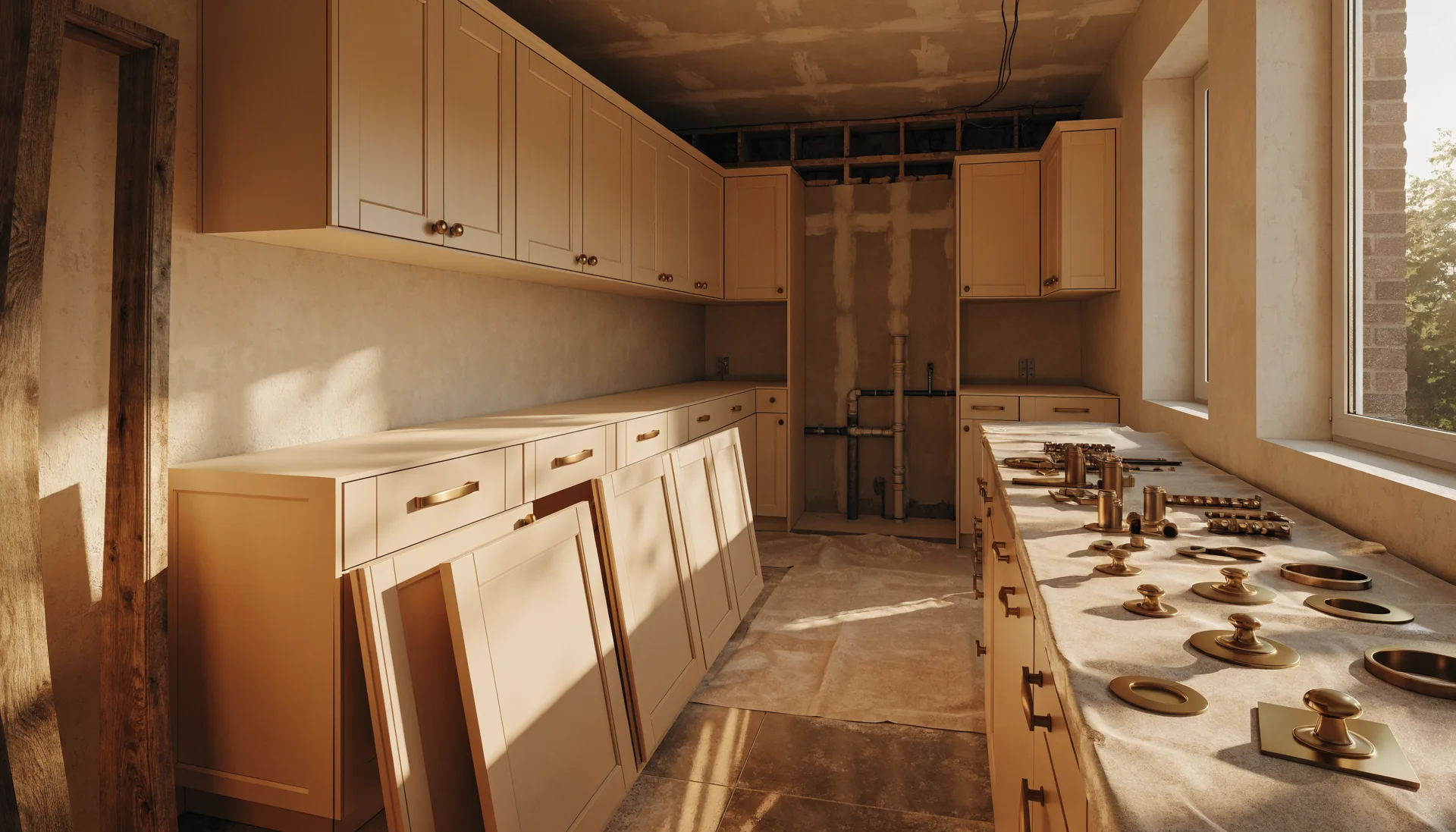
Plan the cabinet line first and the rest of the budget follows.
1-year workmanship warranty · serving 21 communities across Dallas–Fort Worth.
Prefer to talk? (469) 850-7087 · or use the contact page.