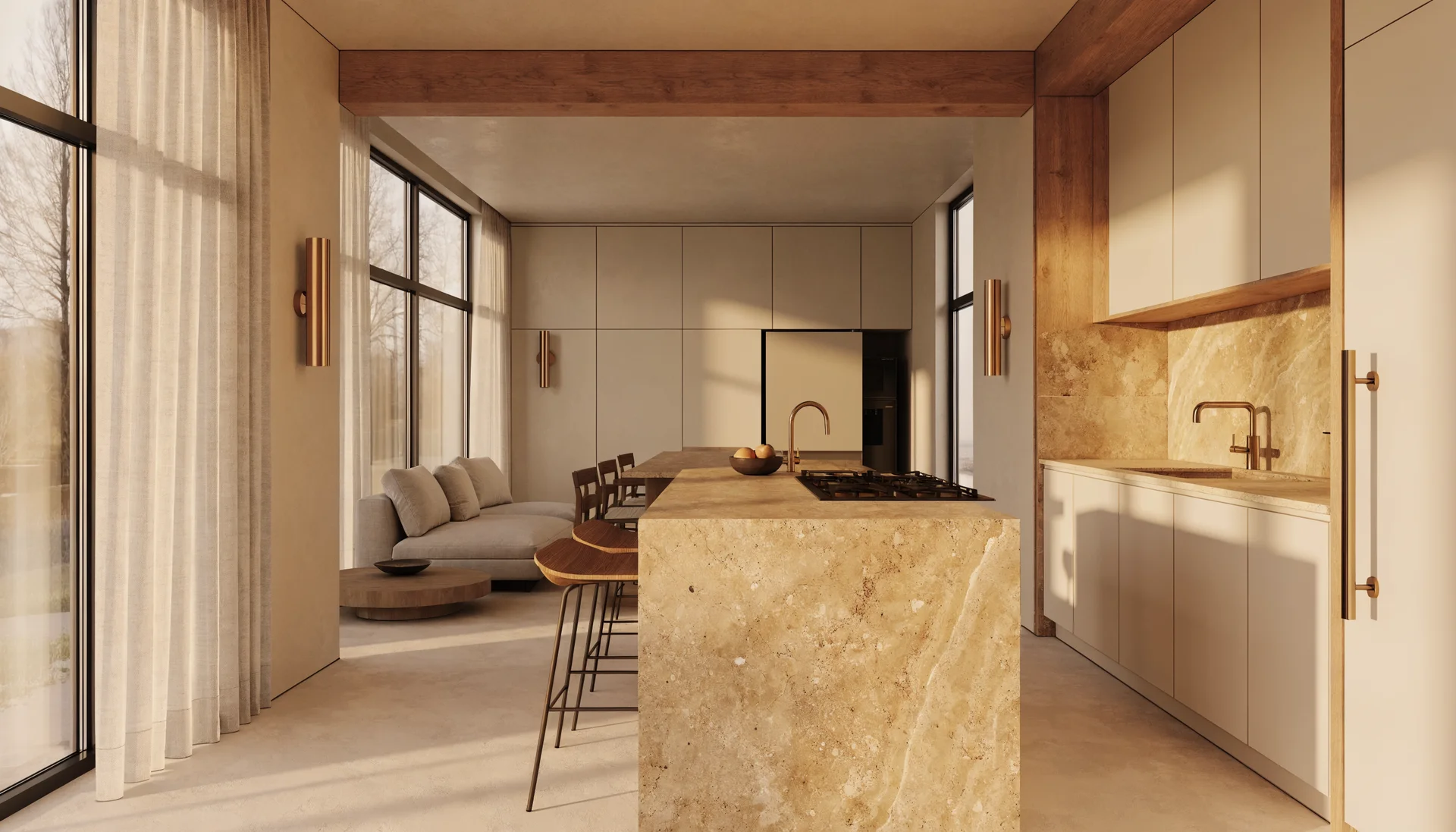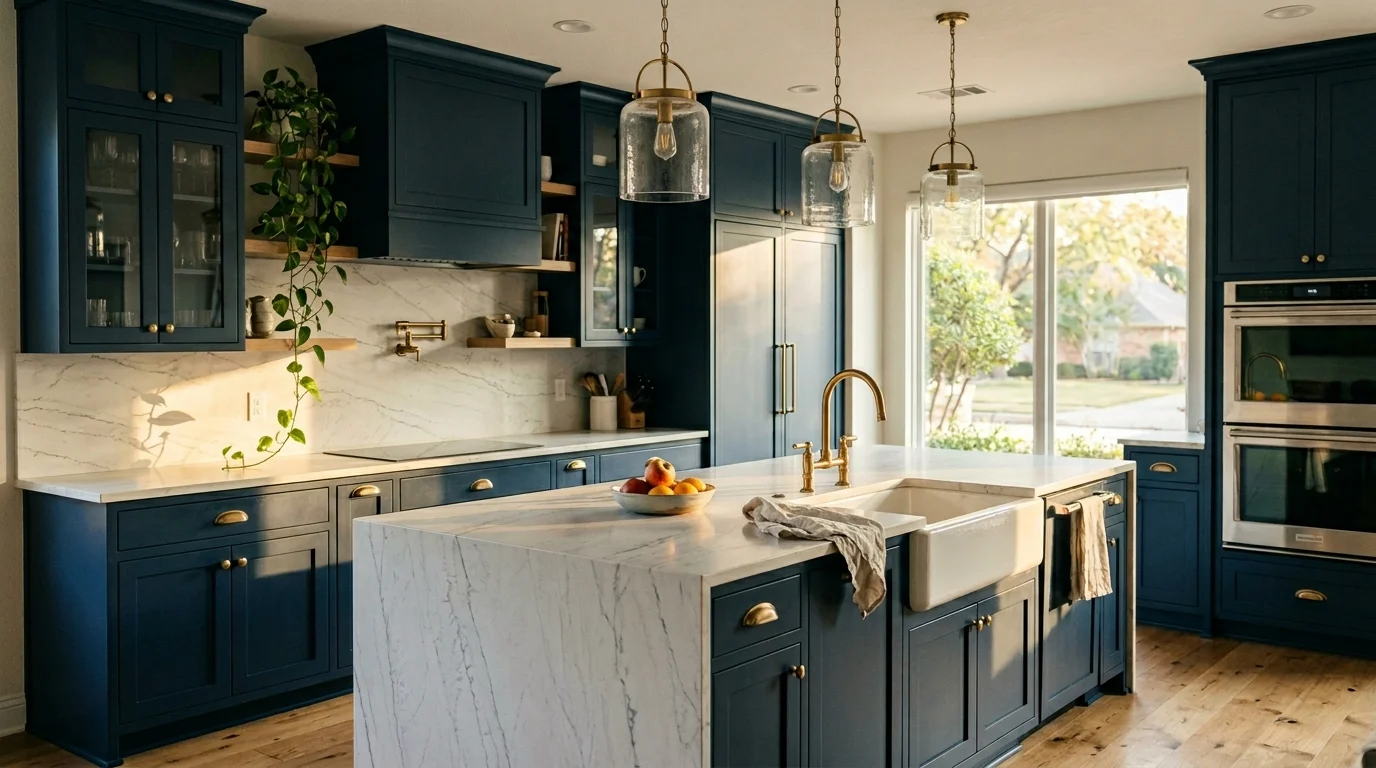

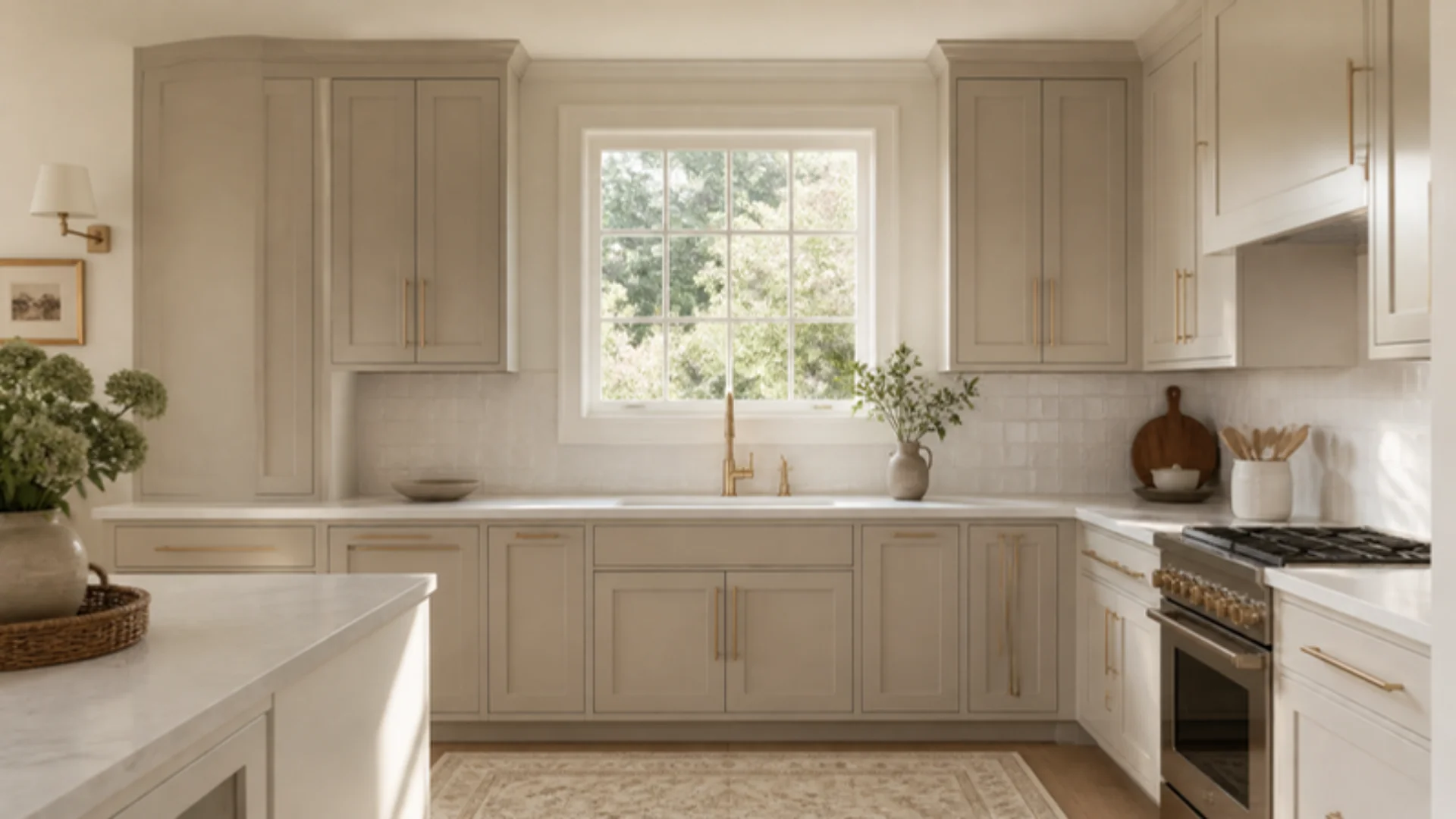
Refinish or Replace Kitchen Cabinets in DFW?
If the cabinet boxes are sound and the layout works, refinishing puts the budget into the surfaces you touch every day. If either one fails, no finish will save the kitchen. Here is how to tell which kitchen you have, with a real Garland kitchen that kept its cabinets.
When a DFW homeowner says “the cabinets look tired,” they usually mean one of two things. Either the cabinets are fine and the surfaces around them have aged, or the cabinets themselves have stopped working. Refinishing answers the first problem well and the second one not at all, which is why this decision starts behind the cabinet doors, not on a paint chart.
Refinish when the boxes are sound and the layout works. Replace when either one fails.
Refinishing sands, primes and repaints the doors, drawer fronts and face frames you already have, usually alongside new countertops, a sink and hardware, so the layout, plumbing and wiring stay put. Refacing puts new doors on the old boxes. Replacing means new boxes, with semi-custom cabinetry alone at $12,000–$28,000, and that is where a cabinet project becomes a kitchen remodel.
This is the contractor-side version of that decision: what refinishing actually involves, five checks that tell you whether your cabinets are candidates, where the money goes in each option, and a real Garland kitchen where the cabinet boxes stayed on the wall and almost everything around them changed.
The Short Answer: The Boxes Decide
Refinish when the cabinet boxes are sound and the layout works for the way you cook. Replace when either one fails. Almost everything else on a homeowner’s list, from the color to the hardware, can be solved by either option. Those two cannot.
There is a middle option, and it is worth naming so the three do not blur together. Refinishing keeps the boxes, doors and drawer fronts and changes the finish. Refacing keeps the boxes and puts new doors, drawer fronts and hardware on them, with the face frames covered to match; our kitchen remodel vs cabinet refacing guide covers it in detail, at $6,000–$15,000 and 3–5 days in DFW. Replacing means new boxes, and that is the point where a cabinet project becomes a kitchen remodel.
If what you dislike is the surface, refinish. If it is the doors themselves, reface. If it is the boxes or the layout, replace.
What Refinishing Actually Involves
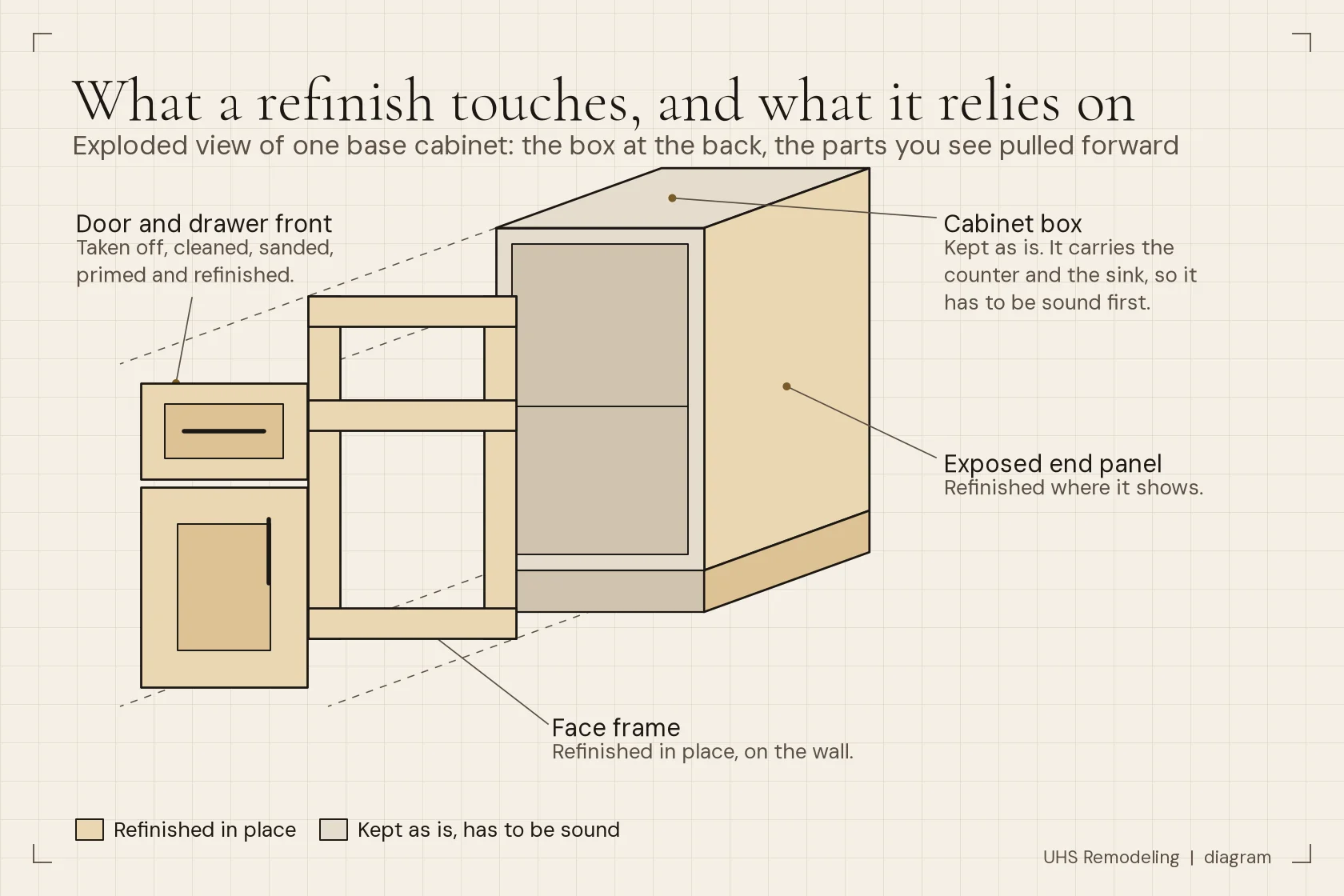
Professional refinishing is preparation with a finish at the end of it. Every door, drawer front, face frame and exposed end panel is cleaned and degreased, sanded, repaired where it is dinged, primed, and then finished with a cabinet-grade coating. The boxes never leave the wall, so the layout, the plumbing and the electrical stay exactly where they were.
It helps to be just as clear about what refinishing is not. It is not a coat of wall paint over years of cooking residue, which is the version that wears through at the handles first. It is not a layout change. And it cannot repair a box that has failed. A refinish makes sound cabinets look new; it does not make tired construction sound.
The hardware comes off for the work, which makes a refinish the natural moment to change it. If the new pulls use a different hole spacing, the old holes are filled and the new ones drilled before the primer goes on, so the change disappears under a painted finish instead of showing through it.
Five Checks That Tell You Which Kitchen You Have
Most of this takes fifteen minutes and a flashlight. Open every door and pull every drawer before you decide anything.
1. The box check
Start under the sink. Swollen or crumbling particleboard, a soft cabinet floor, water stains that climb the side panels, shelves that sag in the middle, and face frames pulling away from the box all point the same way: the box is failing, and no finish will hold it together. One damaged cabinet can sometimes be rebuilt or replaced on its own. Several usually tip the kitchen toward replacement.
2. The door check
Solid wood and MDF doors with a profile you still like are good candidates for a refinish. Thermofoil and some laminate doors are poor ones: once the film starts lifting at the edges, a new finish has nothing stable to bond to. If the boxes are sound but the doors are the problem, that is the refacing case.
3. The layout check
Ask whether you would move anything if money were not the question: the sink, the range, the refrigerator, an island that is not there yet. A refinish keeps every cabinet where it is. If the honest answer is yes, a new finish on the old layout only makes a kitchen you still want to change look better.
4. The appliance check
New appliances do not always fit old openings. A larger refrigerator or a wider range can mean a cabinet has to be cut down, rebuilt or replaced. Settle the appliance list before the cabinet decision, and measure the openings against the specification sheets rather than the old appliance.
5. The storage check
Some storage upgrades fit inside existing boxes: roll-out trays, trash pull-outs, drawer organizers. Others do not. Turning door bases into deep drawer stacks, or adding tall pantry storage where none exists, generally means new boxes. If the storage you want needs new boxes, count them before you assume a refinish covers the kitchen.
Not sure which of these applies to your house? A short conversation settles it faster than any calculator.
Where the Money Goes in Each Option
The three options do not differ by degree. They buy different things. The table shows what each one keeps, what it changes, and the price references already published on this site.
The replacement row is the one that surprises people. Cabinetry is a single line in a kitchen budget, but new boxes pull other lines in with them: demolition, installation, countertops cut to the new boxes, and usually a layout change, because once the boxes are coming out anyway it is the moment to move things. That is why the cabinet decision so often decides the size of the whole project.
Refinishing moves the money the other way. Because the boxes and the layout stay, the budget can go into the surfaces you touch every day: the countertops, the sink and faucet, the backsplash, the hardware and the finish itself.
A Real Example: The Garland Kitchen That Kept Its Cabinets
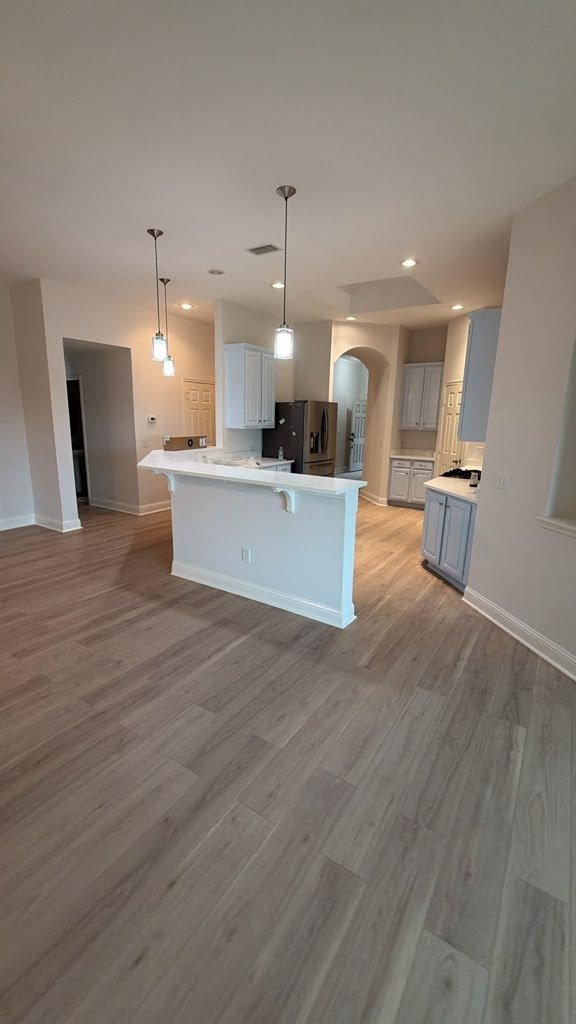
Our Garland whole-house refresh is a refinish done the way this guide describes. The cabinet boxes were structurally sound and the layout worked, but the countertops, the backsplash, the sink and the hardware around them belonged to a different era.
The old countertops, backsplash, sink, faucet and hardware came out. Every cabinet door, drawer front, face frame and exposed base was sanded, prepared, primed and painted with a professional-grade cabinet finish, and the boxes never left the wall. Two quartz slabs were field-measured to the kitchen as it stood, with a new undermount sink and faucet. The homeowners chose the handles and pulls; we installed them. The kitchen was one part of a larger job that also put new floors through the house and fresh paint on the walls, doors and trim.
Keeping the boxes is most of the difference in cost and schedule between that kitchen and a new one. The budget went into the quartz, the sink and the finish instead of into demolition and new cabinetry.
The Order of Work on a Refinish
When the countertops are changing too, the sequence matters. This is the order a refinish with new counters follows, and why each step sits where it does.
Inspect the boxes and doors
Every cabinet is opened and checked, starting under the sink, before the scope is written. A failing box found now is a line in the contract. Found later, it is a change order.
Remove what is changing
The old countertops, backsplash, sink, faucet and hardware come out first, so the finish goes on before the new tops and the two trades are not working on top of each other.
Clean, sand and repair
Every surface is degreased and sanded so the primer has something to grip. Dings are filled, and so are the old hardware holes if the new pulls use a different spacing.
Prime and finish
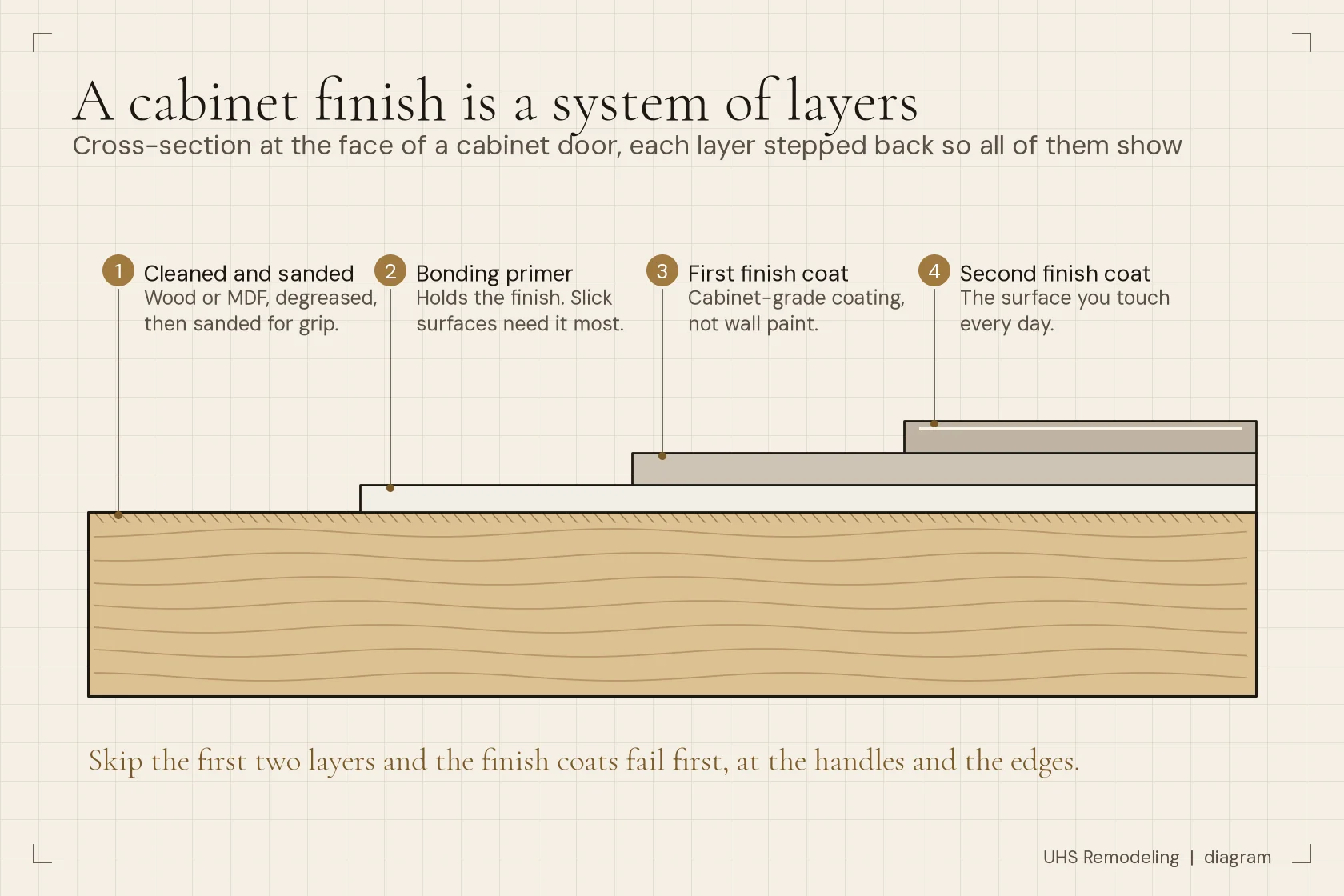
A bonding primer goes on first, then the cabinet-grade finish coats, on the doors, drawer fronts, face frames and exposed ends.
Countertops and sink
The new tops are field-measured to the existing cabinets and installed, with the sink, faucet and plumbing reconnected.
Hardware and sealing
The new handles and pulls go on, the doors are adjusted, and the joints are sealed.
Mistakes That Make a Refinish Look Cheap
Painting over grease
Kitchen cabinets carry years of cooking residue, most of all near the range. A finish applied over it bonds to the residue rather than the cabinet, and it fails first at the handles and the edges.
Skipping the primer
Factory finishes are slick by design. Without sanding and a bonding primer, even a good topcoat has nothing to hold on to.
Doing the doors but not the frames
The doors are the obvious part, but the face frames and exposed ends are in plain view. Refinishing one and not the other leaves two finishes side by side.
Choosing the hardware last
New pulls with a different hole spacing mean filling and re-drilling. Done before the primer, it disappears under a painted finish. Done after the finish, it shows.
Refinishing a failing box
A new finish on a water-damaged sink base looks good for exactly as long as the base holds. Check the boxes first. The finish is the last step, not the fix.
Tell us what you are planning. We will walk your house, tell you what is actually possible, and put a real number on it before you commit to anything.
Or read the numbers first: kitchen remodeling in Plano, TX.
When Replacement Is the Right Call
Replacement earns its cost when the boxes are failing, when the layout has to change, or when the storage you need does not fit the cabinets you have. It is also the right call when this is the kitchen you plan to live with for a long time.
At that point the question is no longer about cabinets. It is a kitchen remodel. Our page on kitchen remodeling in Plano, TX lays out what each level includes, from a same-layout kitchen with new semi-custom cabinetry and quartz in the $25,000–$45,000 range to shop-built custom kitchens at $70,000–$95,000. If you are still working out what to settle first, our guide to what comes first in a DFW kitchen remodel walks through the order, and custom vs stock cabinets compares the cabinet options themselves.
How to Decide This Week
Open every door and drawer. Check under the sink with a flashlight. Write down what you want to change, then sort the list: surfaces (color, counters, sink, hardware) point to a refinish; the doors themselves point to refacing; boxes, layout and storage point to replacement. If the list is mixed, the item that needs the biggest option sets the project.
Then have the kitchen looked at by someone who builds more than one of these. We build both ends: refinished kitchens like the Garland project, where the counters, sink and hardware change around the existing boxes, and full kitchen remodels in Plano and across DFW. Either way, the first thing we will do is open the cabinet under your sink.
Questions we get
Is it better to refinish or replace kitchen cabinets?
Refinish when the cabinet boxes are sound and the layout works for the way you cook; replace when either one fails. Refinishing keeps the boxes, doors and drawer fronts and changes the finish, so the layout, plumbing and electrical stay where they are and the budget can go into countertops, the sink and hardware. If the boxes are water-damaged or you want to move the sink, range or refrigerator, no finish will fix that.
Which is better, cabinet refacing or painting?
It depends on the doors. If the doors are solid wood or MDF with a profile you still like, refinishing (sanding, priming and painting the existing doors and frames, usually alongside new counters) is the simpler option. If the doors are damaged, peeling thermofoil, or a style you no longer want, refacing puts new doors and hardware on the boxes you already have; in DFW that runs $6,000–$15,000 and 3–5 days. Both options need sound boxes and a layout that works.
How do I know if my kitchen cabinets are worth refinishing?
Open every door and start under the sink. Swollen or crumbling particleboard, a soft cabinet floor, water stains on the side panels, sagging shelves or face frames pulling away from the box mean the boxes are failing and a refinish will not hold. Solid boxes, doors you like the shape of, and a layout you would not change are the signs that refinishing is worth it.
Can you refinish cabinets and still get new countertops?
Yes, and it is one of the best combinations when the boxes are sound. The old countertops, sink and hardware come out first, the cabinets are refinished before the new tops go on so the two trades are not working on top of each other, and the new tops are field-measured to the existing cabinets. Our Garland whole-house refresh did exactly this: refinished cabinets, two new quartz slabs, a new undermount sink and the hardware the homeowners chose, on an unchanged layout.
Can you paint thermofoil or laminate cabinets?
They are poor candidates. Even intact film is a slick, heat-sensitive surface that a new finish bonds to poorly, and once a thermofoil or laminate film starts lifting at the edges, the finish fails where the film fails. If the boxes underneath are sound, refacing (new doors on the existing boxes) is usually the better route for those kitchens.
How much do new kitchen cabinets cost in DFW?
In the DFW kitchen remodels we build, semi-custom cabinetry typically runs $12,000–$28,000 for a full kitchen, and fully custom cabinetry generally starts around $30,000. New boxes usually bring demolition, installation and countertops cut to the new boxes with them, which is why replacing cabinets so often becomes a full kitchen remodel; our kitchen remodels run $25,000–$95,000 depending on scope.
Open every door before you choose. Sound boxes and a layout you like mean a refinish, and the money goes into countertops, the sink and hardware. Good boxes with doors you no longer want mean refacing. Failing boxes, or a layout that has to change, mean replacement, and at that point new cabinets are the start of a kitchen remodel, not the whole of it.
Related from the journal

Find out what your cabinets can still do before you price a single new box.
Fully insured · 500+ client reviews · fixed-price contracts · 1-year workmanship warranty.
Prefer to talk? (469) 850-7087 · or use the contact page.