
Custom Cabinets vs. Stock Cabinets Cost Comparison: What Should You Choose for Your Remodel?
Cabinetry is often a significant portion of a kitchen remodel’s cost, and the custom-versus-stock choice is one of the biggest decisions in it. Here is what each option costs per linear foot, what the sticker price leaves out, and how to tell which one your kitchen actually needs.
If you are planning a kitchen remodel in Dallas, Plano, Fort Worth or anywhere else in Texas, the custom cabinets vs stock cabinets decision is one of the biggest you will make. Cabinetry often represents a significant portion of the remodeling bill, and the two options differ in price, quality, function and long-term value. Most homeowners start by comparing cabinet prices alone, then find that installation complexity, material quality, kitchen size, storage needs and design flexibility all move the final number. The choice shapes how the house looks, what it resells for and how the kitchen works every day for years, so it deserves more than a glance at a price sheet.
Stock costs less up front; custom fits the room. Price the whole project, not the boxes.
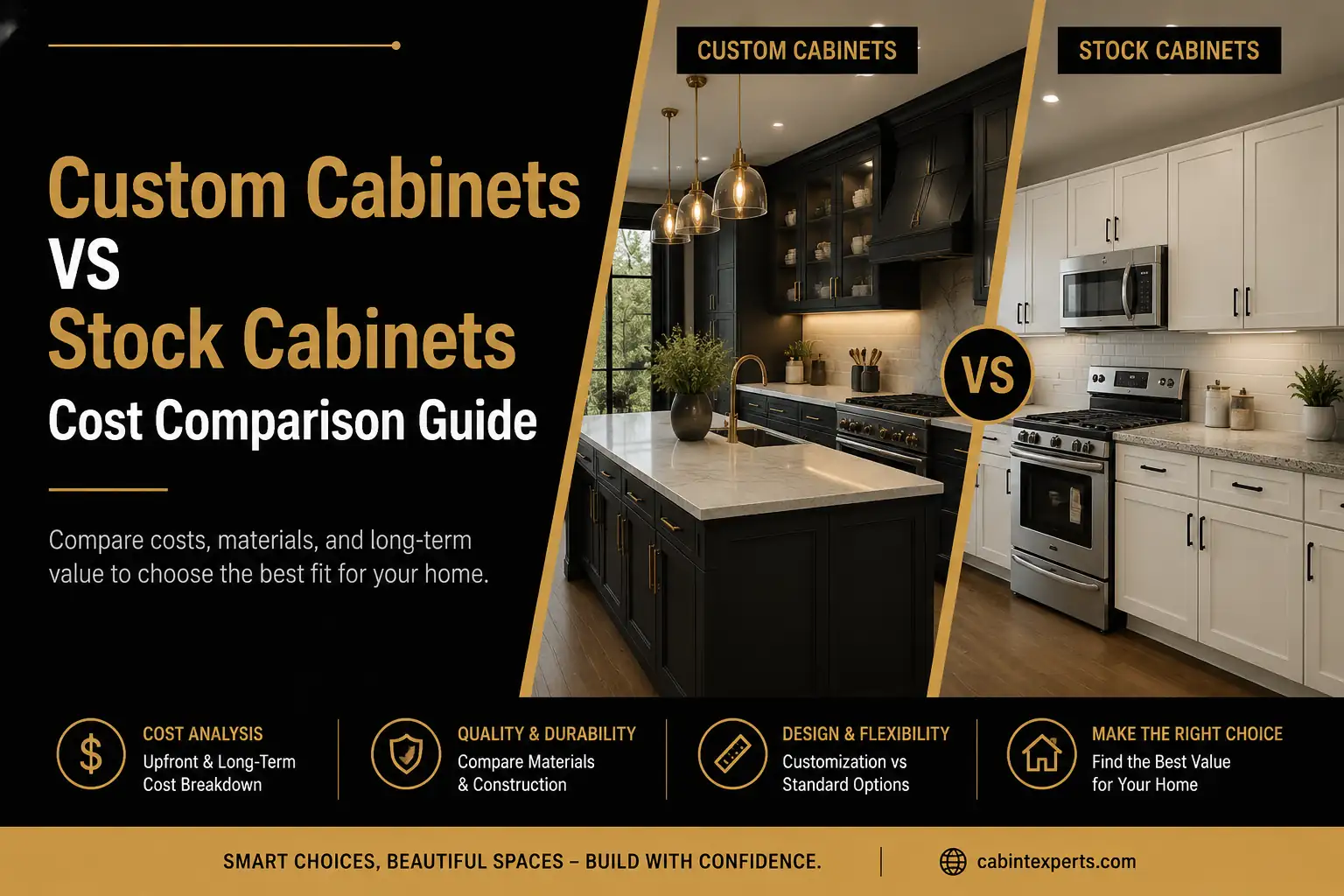
Stock cabinets run $100 to $300 per linear foot and custom $500 to $1,500+, so for a kitchen with about 25 linear feet the gap is wide before demolition, installation labor, countertops, electrical and plumbing are added. Stock wins on cost, speed and predictability; custom wins on fit, storage and finish choice. The right pick depends on your budget, the kitchen’s layout and how long you plan to live with it.
Why custom and stock cabinets are priced so differently
The gap exists because the manufacturing process, the materials, the labor and the level of customization are all different. Stock cabinets are pre-manufactured in standard sizes and produced in large quantities, which gives the manufacturer economies of scale that pull production costs down. Custom cabinets are built specifically for your kitchen dimensions, one kitchen at a time, and each of those steps adds labor that a factory line never has to pay for.
The other differences follow from that. Stock lines offer a limited set of door styles and finishes; custom cabinetry offers nearly unlimited design flexibility. Custom work needs skilled craftsmanship and specialized installation. And the materials themselves often differ substantially, which is a cost line of its own before anyone talks about labor.
Here is what a custom order actually pays for, in the order it happens:
Individualized planning
The cabinets are laid out around your kitchen’s real dimensions, storage needs and workflow, not around whichever standard boxes happen to fit the wall.
Fabrication
Each box, door and drawer is built from scratch to those specifications, in the wood species you chose, rather than pulled from a warehouse shelf.
Finishing
Paint colors and stain finishes are applied to order, which is why the finish options run far past what a stock catalog can offer.
Installation
Skilled craftsmanship and specialized installation fit the pieces to the actual walls and corners, square or not.
Stock production skips every one of those individual steps. The boxes are already built, finished and sitting in a warehouse, which is exactly why the price is lower and the range of choices is narrower.
What custom cabinets are
Homeowners who research what custom cabinets are usually find that they offer significantly more flexibility than the standard alternatives, and that flexibility is the whole reason they cost more. Custom cabinets are built from scratch to your exact specifications. Every element can be tailored: the cabinet dimensions, the storage configurations, the wood species, paint colors, stain finishes, hardware, soft close systems, specialty organizers, decorative moldings and the door style itself. Nothing is chosen from a fixed menu, and nothing has to be worked around.
That flexibility is why custom cabinetry pays off most in particular kitchens: luxury kitchens, historic homes, large kitchen remodel projects, homes with unusual floor plans, and any project where the goal is to get the most storage out of the room or to add to the property’s value. Large remodels in particular benefit from custom work because it maximizes storage, improves workflow and leaves every design choice open. If the remodel reaches beyond the kitchen, our guide on major renovations explains how cabinetry choices affect the planning and budgeting of the whole project.
What stock cabinets are
Stock cabinets are pre-manufactured units built in standard sizes and configurations. You can buy them through home improvement stores, cabinet suppliers and remodeling contractors, and because they are produced in volume they bring real advantages: lower upfront cost, faster availability, simplified ordering, predictable installation timelines and a budget that is easier to hold.
The limits are the other side of the same fact. Customization is limited, dimensions are restricted, finish options are fewer, storage layouts are standard, and in a room the boxes were never designed for there is often wasted space. Stock cabinets work well in many projects; in a more complex layout they may not reach the storage efficiency or the look you are after. Homeowners on tighter budgets can still get excellent results from high-quality stock or semi-custom systems, provided the layout suits them. Semi-custom lines sit between the two on the price sheet.
Not sure which of these applies to your house? A short conversation settles it faster than any calculator.
Custom vs stock cabinet cost, side by side
The most common question we hear is what each option actually costs. Per linear foot, and for a kitchen with roughly 25 linear feet of cabinetry, the ranges look like this:
- Stock cabinets: $100 to $300 per linear foot, or $2,500 to $7,500 for 25 linear feet.
- Semi-custom cabinets: $150 to $650 per linear foot, or $3,750 to $16,250 for 25 linear feet.
- Custom cabinets: $500 to $1,500+ per linear foot, or $12,500 to $37,500+ for 25 linear feet.
Even inside one row the price moves a long way with the materials, finishes, construction method and storage accessories you specify. Installed, Dallas stock cabinet projects tend to land between $5,000 and $15,000, while custom cabinet projects often run $20,000 to $60,000 or more depending on materials, layout complexity and design requirements. For stock cabinets in particular, the total project cost depends on kitchen size, the finishes you select, hardware upgrades, labor and any additional modifications the installation requires.
The cabinet line is also rarely the whole cabinet bill. The final cost may include design consultation, demolition, installation labor, hardware upgrades, countertop coordination, electrical modifications and plumbing adjustments. A quote that lists only the boxes is leaving those out, not avoiding them.
Cabinet prices are the start of the number, not the end of it. Demolition, installation labor, countertop coordination and the electrical and plumbing changes around the new layout all land on the same invoice.
How the two perform after installation
Material quality
Custom cabinets are often built from premium materials: solid wood, furniture-grade plywood, premium veneers and durable finishes. Stock cabinets often use engineered materials chosen to keep manufacturing costs down. Both can be built well, but they are not built from the same things, and the difference matters for how long they hold up under daily use.
Storage efficiency
Custom cabinets use the space better because every cabinet is designed around your kitchen’s size and layout. Stock cabinets, tied to standard sizes, sometimes leave unusable gaps, and those gaps show up as wasted wall and corner areas.
Design flexibility
Homeowners who want complete personalization end up with custom cabinetry, because the level of customization is close to unlimited: built-in spice racks, pull-out shelving, appliance garages, integrated lighting, specialty drawer systems and soft close mechanisms, each placed where you will actually use it rather than where a standard box allows.
I never let a client pick a cabinet line off a price sheet. We measure the room first, decide what the corners and the run beside the range need to do, and only then ask whether stock, semi-custom or custom gets us there.
Where do-it-yourself cabinet planning goes wrong
Plenty of homeowners compare cabinet options on their own before they talk to a remodeler, and that homework is worth doing. The usual methods:
- Visiting big-box retailers
- Comparing online cabinet prices
- Using room design software
- Ordering sample doors
- Measuring the kitchen yourself
- Researching stock or semi-custom lines
All of that provides useful information and helps narrow down what you like before the first conversation with a contractor.
Designing and buying the cabinetry without professional guidance is a different matter, and it tends to create expensive problems. The same mistakes come up again and again:
Incorrect measurements
Boxes that do not fit the wall they were ordered for. Even small measurement errors can result in thousands of dollars in replacement costs.
Poor workflow planning
A kitchen that photographs well and works badly, with storage in the wrong places and the daily routine fighting the layout.
Underestimating installation complexity
An install that turns out to need more trades, more time and more money than the cabinet quote ever suggested.
Overlooking plumbing obstacles
A sink base or a full run that collides with supply lines and drains nobody planned to move.
Ignoring appliance clearances
Doors and drawers that hit the refrigerator, the range or the open dishwasher door.
Choosing incompatible materials
Finishes and components that do not match each other or the rest of the kitchen, and are hard to replace later.
Miscalculating linear foot requirements
Too few cabinets, or too many, and a budget that was wrong from the first line.
Cabinet errors are one branch of a bigger subject. Our article on contractor warning signs covers the other costly remodeling mistakes worth catching early.
Tell us what you are planning. We will walk your house, tell you what is actually possible, and put a real number on it before you commit to anything.
Or read the numbers first: kitchen remodeling in Plano, TX.
The value the cabinet price does not show
The upfront cost is where most homeowners stop, but the real value of cabinetry includes how long it lasts, what it costs to maintain, how it reads to a buyer and how it works every day. The U.S. Environmental Protection Agency makes the case for durable, sustainable building materials as part of healthier indoor air and longer-lasting renovations in its EPA Indoor Air Quality Guide, and housing and design education programs such as the University of Minnesota Housing Resources make the same point: quality materials tend to produce better long-term performance and more satisfied homeowners.
Cabinets are also one of the most visible and most used features in the kitchen, so choosing the wrong system creates problems that outlast the remodel. Upfront price is the number everyone compares; long-term performance is the one everyone lives with. The common problems: too little storage, wasted wall and corner areas, premature wear and tear, lower resale appeal, limited room for future upgrades, difficulty matching replacement components, a kitchen that simply works worse, and higher maintenance costs.
The mistake runs both ways. Picking stock cabinets only because they look cheaper can build in storage inefficiencies that annoy you every single day. Paying for custom cabinetry when a stock solution would have met the need adds to the project cost for nothing. Industry bodies such as the National Association of Home Builders count cabinetry quality as a real contributor to overall remodeling value, which is another way of saying the decision is worth getting right rather than getting fast.
Resale is part of the same calculation. Custom kitchen cabinets often provide stronger resale appeal in higher-end markets, because buyers notice premium finishes, optimized storage and a design that is unique to the house, while quality stock cabinets can still return an excellent investment in many neighborhoods. Custom cabinets are often worth the extra cost for homeowners who want maximum storage efficiency, unique designs, premium materials and long-term durability; professionally designed and installed, they typically use the space better and can add to overall property value.
Stock cabinets bought only because they looked cheaper can cost you storage every day; custom cabinets bought where stock would have done the job cost you money for nothing.
When a kitchen needs a remodeler, and how we handle it
Choosing cabinetry sounds straightforward, and many projects turn out far more involved than the homeowner expected. Professional remodeling help is strongly recommended when any of these apply:
- Your kitchen has an unusual layout
- The walls are not square
- You are relocating appliances
- Electrical work is required
- Plumbing modifications are needed
- You want custom storage solutions
- You need permit guidance
- You are investing in high-end cabinetry
Complex remodels mean coordinating cabinet installers, electricians, plumbers, countertop fabricators and inspectors, and a planning mistake ripples into every phase of construction. Each of those conditions changes who has to be on site and when, and that is the part a cabinet price sheet cannot tell you. For a whole-house project, our guide to successful planning covers the preparation.
UHS Remodeling approaches the custom-versus-stock question by evaluating the whole project instead of the cabinet cost on its own. The question was never only about price. It is about how the cabinetry affects the way the kitchen functions, how it looks, how long it lasts and what it adds to the home’s value, and those things rarely point the same way as the cheapest quote. Evaluating the whole project means our approach covers:
- Detailed project consultation
- Accurate measurements
- Professional design guidance
- Material selection assistance
- Cabinet layout optimization
- Transparent budgeting
- Skilled installation
- Project management from start to finish
Stock, semi-custom or fully custom, the aim is the same: the most value for the budget and a kitchen that performs well for years. You can see how that plays out on our kitchen remodeling in Plano, TX page.
The right answer depends on far more than cabinet prices. Budget, kitchen size, storage requirements, design goals, how long you expect the cabinets to last and what the house is worth afterward all decide it. Stock cabinets are the right call for affordability and a quick install; custom cabinets give the most flexibility, premium craftsmanship and a kitchen built around the household. Before you commit, have an experienced remodeler evaluate the space, walk through the custom options and steer you clear of the expensive mistakes. If your kitchen is in Dallas, Plano, Fort Worth or anywhere in Texas, contact us to schedule a consultation and look at cabinetry solutions designed for your home and your budget, or start with our Plano kitchen remodeling service page to see what a full project includes.
Questions we get
Custom vs Stock Cabinets: Which Is Better?
Neither option is universally better. Stock cabinets are ideal for budget-conscious projects and faster installations, while custom cabinets provide superior flexibility, storage optimization, and design personalization. The best choice depends on your budget, kitchen layout, and long-term remodeling goals.
Custom Cabinets vs Stock: Are Custom Cabinets Worth the Extra Cost?
Custom cabinets are often worth the investment for homeowners seeking maximum storage efficiency, unique designs, premium materials, and long-term durability. They typically provide better space utilization and can enhance overall property value when professionally designed and installed.
Custom Cabinets vs Stock Cabinets: What Is the Biggest Difference?
The biggest difference is customization. Stock cabinets are manufactured in standard sizes with limited options, while custom cabinets are built specifically for your kitchen dimensions, storage needs, finishes, and design preferences, providing significantly greater flexibility.
What Is the Cost of Stock Cabinets?
The cost of stock cabinets generally ranges from $100 to $300 per linear foot before installation. Total project costs depend on kitchen size, selected finishes, hardware upgrades, labor expenses, and any additional modifications required during installation.
What Are Custom Cabinets and Why Do They Cost More?
Custom cabinets are individually designed and built to match a homeowner’s exact specifications. They cost more because they require personalized design work, skilled craftsmanship, premium materials, custom finishes, and additional labor throughout manufacturing and installation.
Custom Kitchen Cabinets vs Stock Cabinets for Resale Value?
Custom kitchen cabinets often provide stronger resale appeal in higher-end markets because buyers appreciate premium finishes, optimized storage, and unique designs. However, quality stock cabinets can still offer excellent return on investment in many neighborhoods.
How Much Does a Custom Cabinets vs Stock Cabinets Cost Comparison Dallas Project Usually Cost?
Dallas homeowners can expect stock cabinet projects to range from approximately $5,000 to $15,000 installed, while custom cabinet projects often range from $20,000 to $60,000 or more depending on materials, layout complexity, and design requirements.
Stock cabinets are the right call when affordability and a fast install matter most; custom cabinets are the right call when the layout is unusual, storage is tight or you want the finish and detail chosen for the room. Either way, price the whole job, measure before you order, and have a remodeler check the layout before the boxes arrive.
Related from the journal
Get the cabinet decision priced for your kitchen stock, semi-custom or custom.
Fully insured · 500+ client reviews · fixed-price contracts · 1-year workmanship warranty.
Prefer to talk? (469) 850-7087 · or use the contact page.