
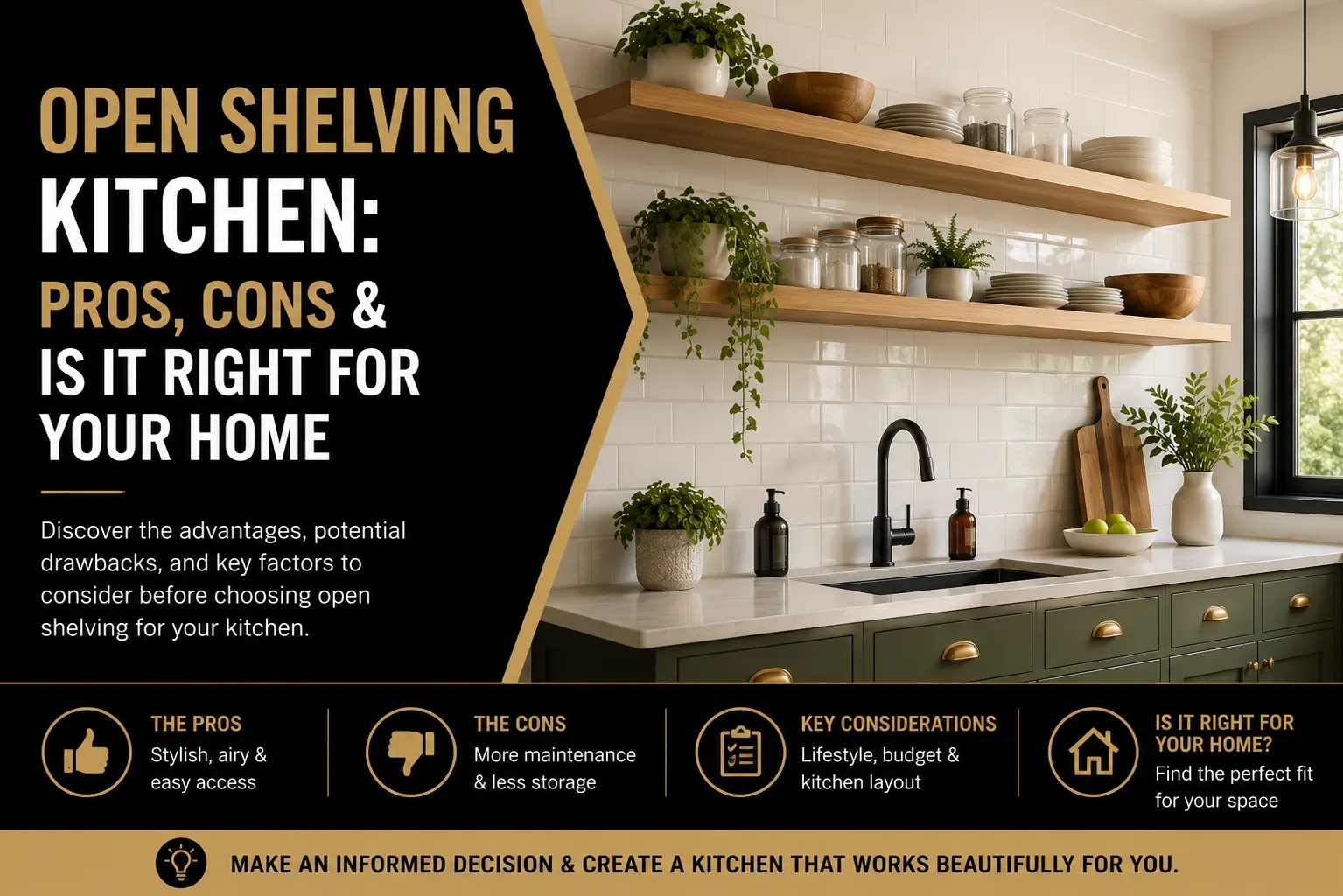
Open Shelving Kitchen Pros and Cons: Is It the Right Choice for Your Home
Open shelves make a kitchen feel bigger and brighter and put everyday dishes within reach. They also collect grease, hold less, and need constant tidying. Here is how to decide, and why a mix of shelves and cabinets is usually the answer.
The debate over open shelving kitchen pros and cons keeps growing as more homeowners look for a kitchen that feels modern, works hard, and looks good doing it. Open shelves have become a defining feature of contemporary kitchen design, and in many remodeling projects they replace the traditional upper cabinets outright. The look is easy to like. The harder question is whether kitchen open shelving is practical for the way your household actually lives, and that depends on your storage needs, your tolerance for upkeep, and what you want the remodel to do for the home over the long term. In 2026, a kitchen is expected to balance style, organization, function, and lasting value all at once, so before you swap cabinets for shelves it is worth understanding both sides honestly.
Open shelving works if you will keep it organized; the most successful kitchens mix shelves with cabinets.
Open shelves make a kitchen feel larger, brighter, and more personal, and they put daily-use items within reach. They also collect dust and grease, hold less than cabinets, and demand constant tidying. The layout designers recommend most often pairs open shelves with closed cabinets.
Why open shelving has become so popular
The popularity of the open shelf concept comes from a broader shift toward cleaner, brighter, more personal kitchens. Homeowners want the room to feel larger and more welcoming, and taking down bulky upper cabinets does that immediately. The wall opens up, and the things you actually use and like looking at become part of the design instead of hiding behind doors.
Layout is the other driver. Many modern kitchens open directly into the living room and dining area, and a run of solid upper cabinets can read as a wall between the two. Open shelving ties those spaces together while displaying dishware, plants, artwork, and accessories that carry the same palette through the whole floor. In an open plan the kitchen is on view from the sofa, so the shelves end up doing double duty as the decor of the room.
Several things keep shelving in the kitchen in steady demand:
- It creates an airy, spacious appearance
- Everyday items sit within easy reach
- It encourages better organization, because everything is in view
- It gives you room for decorative displays
- It works well in small kitchens
- It suits modern, farmhouse, industrial, and transitional styles
- It can reduce cabinetry costs on some projects
Homeowners researching modern kitchen trends keep arriving at the same finding: open shelving remains one of the most requested design features heading into 2026.
The pros of an open shelving kitchen
Five advantages come up in nearly every conversation about open shelving.
1. The kitchen feels larger
Visual expansion is the biggest advantage. Traditional upper cabinets create solid walls that can make a kitchen feel confined, and open shelves remove that barrier. The eye travels to the back wall instead of stopping at a cabinet face, so the same square footage reads as a bigger room.
That matters most in smaller homes, condos, and older Texas properties, where the kitchen footprint is fixed and every bit of perceived space counts.
2. Everything is easier to reach
Items on an open shelf are easier to grab than items behind a cabinet door. The dishes, glasses, bowls, and cookware you use every day stay in plain sight and within reach. For a busy family that shortens meal preparation and removes a small daily frustration, the kind you stop noticing until it is gone.
3. Storage becomes part of the design
Open shelving turns storage into a design element. Homeowners use the shelves to display ceramic collections, cookbooks, decorative dishes, plants, artwork, family heirlooms, and glassware. The result is a kitchen that reflects the people who live there rather than a standard builder-grade space that could belong to anyone.
4. It keeps you organized
Because everything stays visible, homeowners naturally keep the shelves in better order. Clutter shows immediately, which encourages consistent upkeep. Many of our clients find they accumulate fewer unnecessary kitchen items after switching to open shelving, simply because there is nowhere for the extras to hide.
5. More natural light moves through the room
Removing upper cabinets lets light travel across the room instead of stopping at a cabinet box. Better light distribution makes a kitchen feel cleaner, brighter, and more inviting. Guidance on home environments published by the U.S. Environmental Protection Agency makes the broader point that a well-designed interior contributes to a healthier, more comfortable living space.
The cons every homeowner should weigh
The benefits are real, but so are the drawbacks, and the cons of open shelving are what decide whether the look survives a year of real cooking.
1. Dust and grease settle on everything
This is the most common complaint. Dust, cooking oils, and airborne particles settle on exposed items, and unlike an upper cabinet, an open shelf offers no barrier against any of it. Households that cook often end up washing displayed items more regularly than they expected.
2. It demands consistent organization
Open shelving leaves no room for hidden clutter. Every item becomes part of the kitchen’s visual presentation, and if the organization slips, the room quickly looks messy and overcrowded.
3. Less storage capacity
Traditional upper cabinets typically hold more than open shelving does. Large appliances, food storage containers, and miscellaneous kitchen items still need a home, which usually means finding storage somewhere else in the plan.
4. Fragile items are exposed
Dishes and decorative pieces stay vulnerable to accidental bumps, impacts, and falls. Families with young children tend to feel this one most.
5. It does not fit every lifestyle
Busy households that put convenience ahead of looks may struggle with the maintenance an open shelf installation asks for. There is no shame in that; it is simply a different set of priorities.
Set side by side, the trade-offs look like this:
- Pro: a more open and spacious kitchen. Con: items exposed to dust, grease, and cooking residue.
- Pro: easier access to daily-use items. Con: constant organization and maintenance.
- Pro: better natural light and visual flow. Con: less hidden storage than cabinets.
- Pro: decorative, personalized styling. Con: no place to hide mismatched or bulky items.
- Pro: can reduce cabinet installation costs. Con: can feel cluttered if not carefully arranged.
- Pro: suits modern and open-concept homes. Con: less suited to high-traffic, busy family kitchens.
Open shelves trade hidden storage for light and display. The kitchens that get it right decide up front which items earn a place in view and where everything else will live.
Not sure which of these applies to your house? A short conversation settles it faster than any calculator.
Open shelves and cabinets together: the mixed approach
Many homeowners ask whether a mixed shelf offering gives them the best of both worlds. In most cases, the answer is yes.
Rather than removing every upper cabinet, designers usually combine open shelving with traditional closed storage. The hybrid keeps the visual openness where it counts and preserves concealed storage where you need it, which is how the look holds up in a kitchen that gets used hard every day.
The mixed layouts we see most often:
- Open shelves around windows
- Floating shelves above a coffee station
- Cabinets on one wall and shelves on another
- Glass-front cabinets paired with open displays
- Shelving around the range hood
For most real households this delivers the right balance of looks and practicality, and it is the version designers recommend most often in full kitchen remodel planning.
Where the open shelves go matters as much as how many there are. Around a window or above the coffee station they hold the few things that get used every morning, while the closed cabinets on the other wall take the mismatched containers and the small appliances nobody wants on display.
I ask clients to walk me through a normal week of cooking before I take a single upper cabinet off the drawing. If the everyday dishes have a home on the shelf and the blender does not, the mix is right.
DIY open shelving: the steps, and why so many projects fail
Plenty of homeowners attempt a DIY shelf installation after watching online tutorials. A simple project can look straightforward on screen, but professional installation usually produces a safer and more durable result, and the reason is in the steps themselves.
What a DIY installation involves
Locate the wall studs
Every shelf that will carry real weight needs to fasten into framing, so the first job is finding exactly where the studs sit behind the drywall.
Select the bracket system
Different bracket systems carry different loads and mount differently, and the choice has to match what the shelf will actually hold.
Measure the shelf spacing
Spacing decides whether tall glassware, stacked plates, and cookbooks fit, and it has to be worked out before a single hole is drilled.
Set the shelves level
A shelf that is even slightly off level shows in every plate and glass sitting on it.
Anchor heavy loads properly
Dishes and cookware add up quickly, so the fasteners have to be sized for the full load rather than the empty shelf.
Finish the shelf surfaces
The shelf surface still needs finishing before anything goes on it, and that step is easy to rush at the end of a long weekend.
Each of those steps seems manageable on its own. The trouble is that the technical challenges arrive together, in a wall that already carries wiring and plumbing you cannot see.
Why DIY open shelving projects often fail
Most homeowners underestimate the structural demands of kitchen shelving. Open shelves routinely carry significant weight from dishes, cookware, and decorative items, and the wall behind them was never planned with that load in mind. The same mistakes show up again and again:
Incorrect anchor selection
An anchor meant for something light is asked to hold a shelf of plates, and it lets go.
Missing the wall studs
Fasteners sunk into drywall alone pull out under load and take part of the wall with them.
Uneven shelf placement
Shelves that do not line up with each other, or with the cabinets nearby, look wrong from across the room.
Insufficient weight support
The shelf sags in the middle once the dishes go on and never recovers.
Improper spacing
Tall items do not fit, and the shelves end up half-used.
Inconsistent shelf alignment
Small variations from shelf to shelf add up to a wall that reads as sloppy.
Ignoring electrical or plumbing lines
A screw driven into a wire or a supply line turns a weekend project into an expensive repair.
The consequences range from sagging and wall damage to expensive repairs and real safety hazards. Homeowners planning a larger renovation should also read our guide on contractor mistakes so the same shortcuts do not show up in the professional work either.
How open shelving affects home value
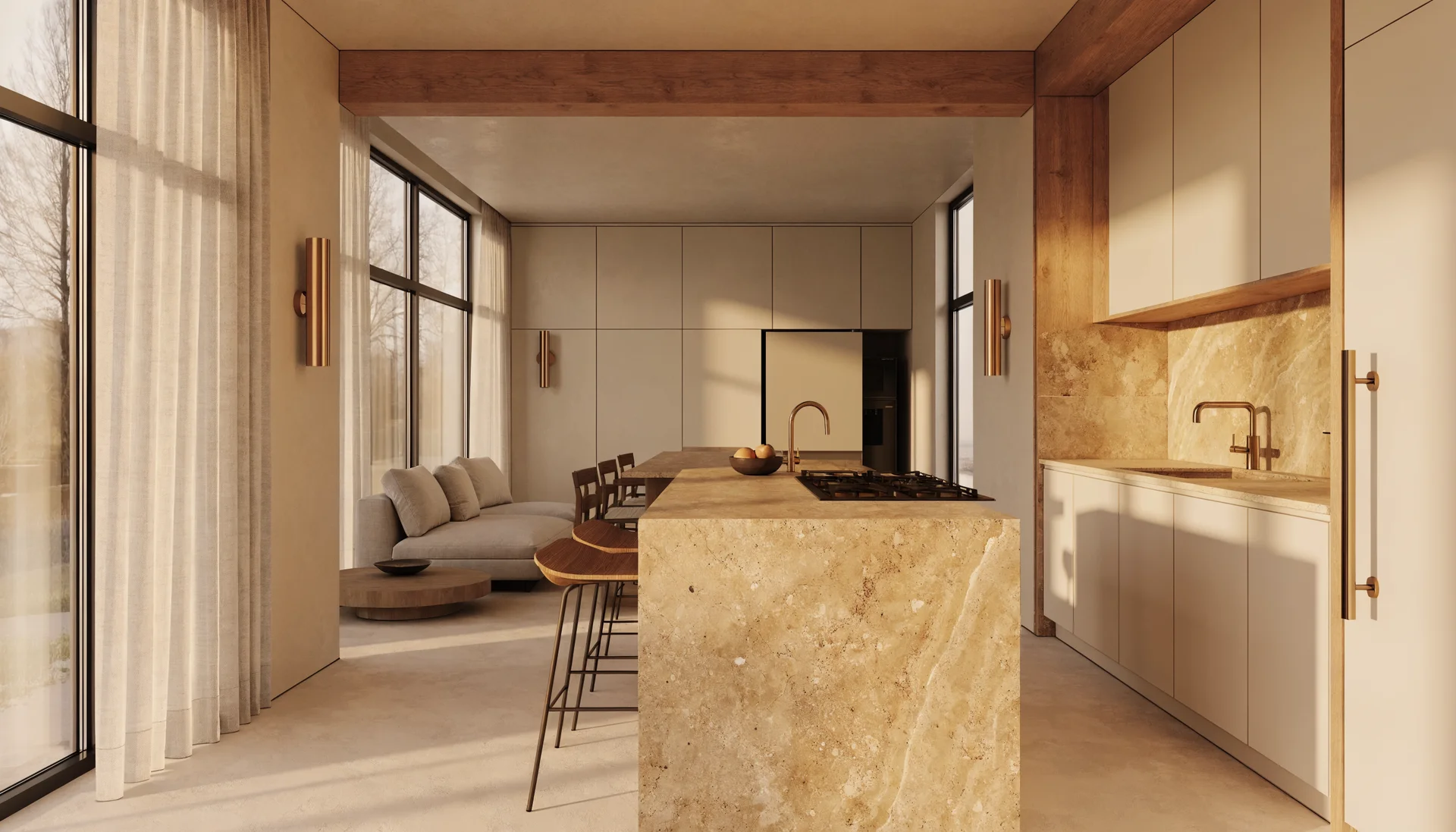
Resale value is one of the most common questions we get about open shelving, and the answer depends almost entirely on execution.
A professionally designed shelving system that is integrated into a larger kitchen remodel tends to improve how buyers see the kitchen. Poorly installed shelves do the opposite: a sagging or crooked shelf reduces the appeal of the whole kitchen.
Buyers generally respond well when:
- The kitchen still works as a kitchen
- Enough storage exists elsewhere
- The design feels intentional rather than improvised
- The materials suit the architecture of the house
- The shelves were professionally installed
If return on investment is the deciding factor for you, our article on kitchen ROI goes deeper.
The common thread is that buyers do not judge the shelves in isolation. They judge whether the kitchen still works and whether the storage that was removed went somewhere sensible.
What research says about organization and design
Studies in environmental psychology suggest that organized spaces can improve comfort and how functional a room feels. Educational resources from institutions such as the Utah State University Extension Interior Design Program put storage planning and thoughtful interior layout at the center of good design. Open shelving works best when the household commits to keeping it organized and visually consistent, which is the same conclusion the research points to.
Tell us what you are planning. We will walk your house, tell you what is actually possible, and put a real number on it before you commit to anything.
Or read the numbers first: kitchen remodeling in Plano, TX.
When it is time to hire a remodeling company
Several situations push open shelving into professional territory:
- The project involves relocating electrical
- You are removing upper cabinets
- Walls need structural modification
- You want custom shelving built for the space
- You are planning a complete kitchen remodel
- You need guidance on permits
- You want the maximum resale value from the work
- You need integrated lighting or custom cabinetry
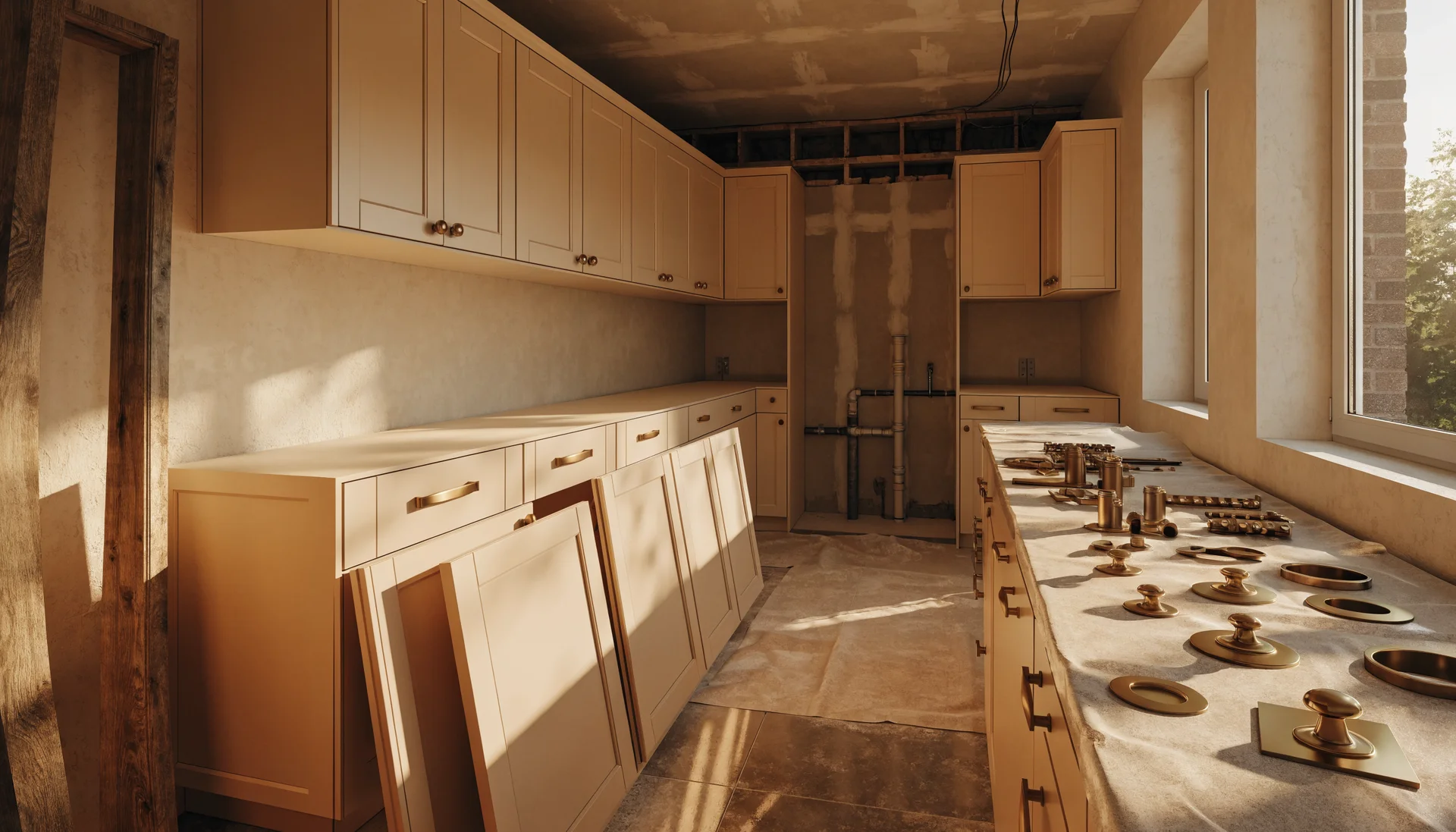
Removing upper cabinets in particular is where a tutorial stops being enough. The wall behind them, the wiring inside it, and the finishes that have to meet the new shelves are all part of the job, and they are the parts a homeowner cannot see before the cabinets come down.
The National Kitchen and Bath Association consistently stresses professional planning and design as the route to a functional, code-compliant kitchen renovation, and open shelving is no exception once walls, wiring, or cabinets are involved.
Kitchen remodeling asks for more than installing shelves. It asks for an understanding of how design, storage, lighting, workflow, materials, and construction work together in one room. That is how we approach kitchen remodeling in Plano, TX: custom kitchen design, detailed project planning, code-compliant construction, storage worked out around how you cook, and plain communication from the first meeting to the final walkthrough. From open shelving to custom cabinetry to a full kitchen remodel, professional guidance is what makes the investment hold up.
Making the right choice for your kitchen
Understanding the open shelving kitchen pros and cons before you commit saves you from living with a decision that looked better on a screen than in a working kitchen. Open shelving delivers a clean, modern look and puts everyday items within reach, and it also brings maintenance, less storage, and exposure to dust and grease.
The most successful kitchens usually take the balanced route: open shelves where they add light and display, traditional cabinetry where things need to be put away. That hybrid keeps the room practical for daily use while still reflecting your own style.
If a kitchen upgrade is on the horizon, settling the layout early in the process saves time, money, and frustration later. A professional remodeling plan makes sure storage, workflow, and design all work together, which is exactly where a Plano kitchen remodel with UHS Remodeling starts.
Related guides from UHS Remodeling:
- Mudroom Remodel Ideas for Small Homes
- What to Expect During a Home Remodel in DFW
- Interior Archway Design Trends
- How Much Does a Home Remodel Cost in DFW?
Questions we get
Is mixed shelf offering good or bad?
Mixed shelf offerings are generally a good solution when homeowners want both style and practicality. They combine open shelving for display with closed cabinets for storage, reducing clutter while maintaining a modern aesthetic. This hybrid approach is often recommended in full kitchen remodel planning.
What do open shelf reviews magazine articles say?
Most open shelf reviews magazine features highlight the strong visual appeal and modern design flexibility of open shelving kitchens. However, they also consistently mention drawbacks such as dust buildup, limited hidden storage, and the need for ongoing organization to maintain a clean appearance.
Is kitchen open shelving still trending in 2026?
Yes, kitchen open shelving remains highly popular in 2026, especially in modern and minimalist kitchen design. Homeowners continue to choose shelves for their airy look and accessibility, though professionals increasingly recommend blending them with upper cabinets for balance and long-term functionality.
Are shelves instead of cabinets a good idea?
Using shelves instead of cabinets can work well for homeowners who prioritize aesthetics and easy access. However, it may not suit those who need maximum storage or prefer hidden organization. A mixed design is often the most practical solution in real homes.
What is an open shelf kitchen design best suited for?
An open shelf kitchen design works best in homes that value visual openness, a modern look, and carefully styled shelves. It is especially effective in smaller kitchens or open-concept layouts where upper cabinets might feel heavy or restrictive.
How difficult is it to maintain open shelving kitchens?
Open shelving kitchens require more maintenance than traditional cabinetry. Items are exposed to dust, grease, and kitchen activity, meaning regular cleaning is essential. Homeowners must also maintain consistent organization to avoid a cluttered appearance.
Do open shelves affect home resale value?
Open shelves can positively influence resale value when integrated into a professionally designed kitchen remodel. Buyers generally appreciate modern, well-designed shelving systems, but poorly executed DIY installations may reduce buyer interest.
Open shelving gives you light, reach, and a kitchen that looks like yours; it takes away hidden storage and adds upkeep. Pair shelves with cabinets, plan a home for everything that should not be on display, and have the structural work done by someone who finds the studs and the wiring before drilling.
Related from the journal
Plan the kitchen wall before the cabinets come down with a Plano remodeler who plans the storage first.
Fully insured · 500+ client reviews · fixed-price contracts · 1-year workmanship warranty.
Prefer to talk? (469) 850-7087 · or use the contact page.