
Why Are Prosper Homeowners Customizing Nearly-New Homes in 2026?
The house is five years old and nothing is broken. The remodel is about closing the gap between builder allowances and the home you actually wanted.
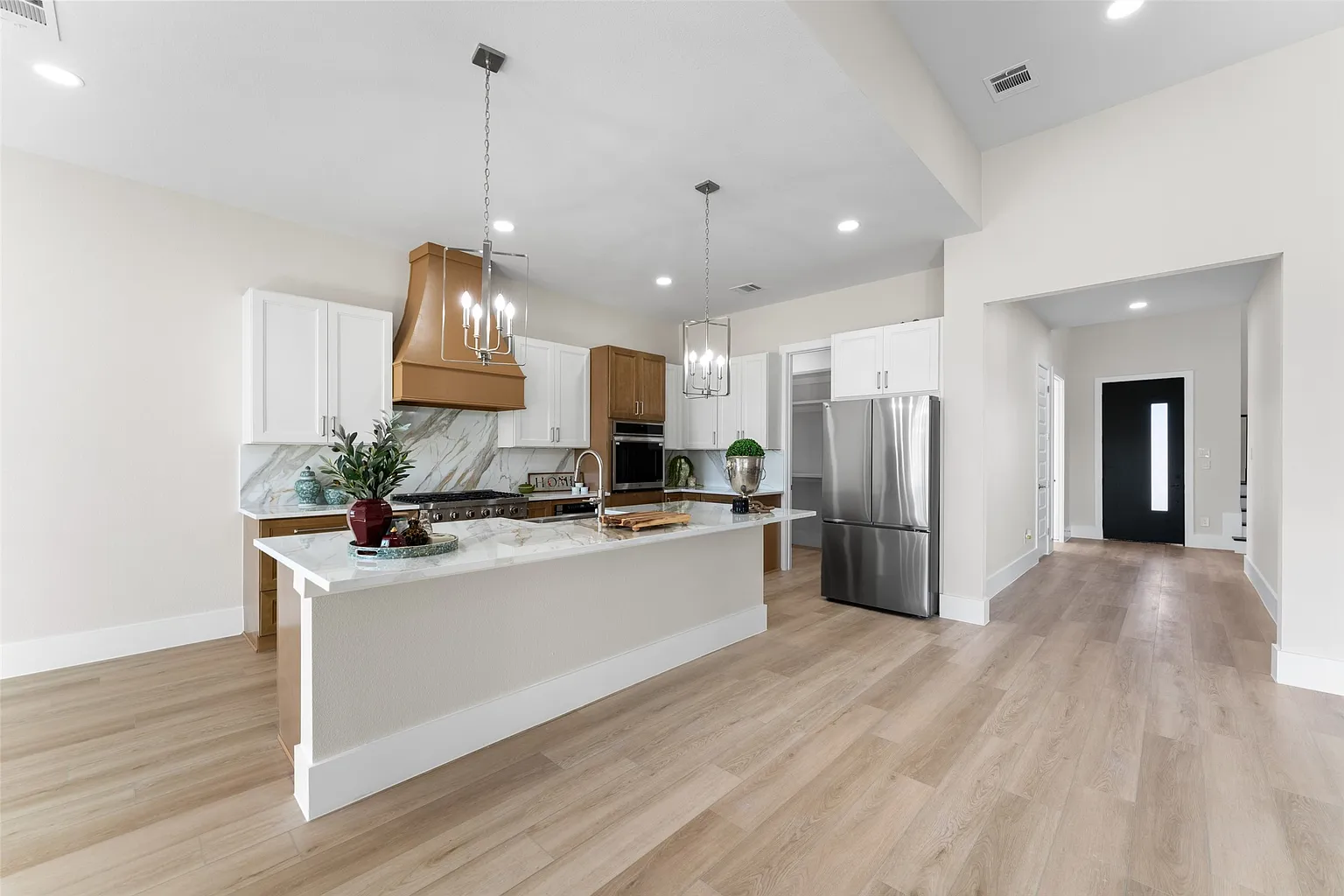
Roughly 91% of Prosper homes were built after 2000, yet finish-out remodels are among the most common projects in town. Owners typically invest $25,000-$95,000 to take a builder-grade kitchen to true custom, $8,000-$60,000 on primary baths, and $95,000-$350,000 for whole-home customization. The driver isn’t age or decay. It’s the gap between what the builder’s option sheet offered and the home the family actually wanted.
New House, Custom Finish
Prosper’s housing stock is overwhelmingly new (about 91% built since 2000, median build in the early 2010s), so remodeling here means personalizing, not repairing. In 2026, taking a builder-grade kitchen to custom runs $25,000-$95,000, primary bath upgrades run $8,000-$60,000, whole-home finish-outs run $95,000-$350,000, and additions run $120,000-$400,000. A real example: a nearly-new Frisco builder home got a full custom kitchen for $85,000 fixed-price in 8 weeks. Permits go through the Town of Prosper’s Building Inspections Division.
Prosper has one of the youngest housing stocks in North Texas. Roughly 91% of homes here were built after 2000, the median build year falls in the early 2010s, and the town has grown from about 9,400 residents in 2010 to an estimated 46,000–51,000 today, with roughly 72,000 projected at buildout. In an older suburb, remodeling usually means repairing what wore out. In Prosper, it almost always means something different: closing the gap between what a production builder offered and what your family actually wanted.
§ 01Why would anyone remodel a house that is only five years old?
Because nothing about a production home was ever designed specifically for you. Roughly 56% of Prosper’s homes went up between 2010 and 2019, most of them in fast-growing master-planned communities like Windsong Ranch and Star Trail. Builders working at that pace standardize everything (cabinet lines, tile choices, lighting packages), so a house that appraises beautifully can still feel generic the day you move in.
Three things push owners of nearly-new homes to remodel. First, the option sheet: structural and finish upgrades were expensive at build time, so many buyers declined them and planned to do it later. Second, life changed: a home bought in 2016 may now need a real home office, a media room, or a bathroom that works for visiting parents. Third, finishes date faster than structures. Builder-grade espresso cabinets and beige tile from 2012 read as a different era next to 2026 selections, even though the bones are excellent.
That last point matters, because excellent bones are exactly why remodeling a newer home is efficient. The foundation, framing, roof, and mechanicals are modern, so nearly every dollar goes into the finishes you see and use, not into undoing forty years of deferred maintenance.
§ 02What is the difference between builder allowances and true custom?
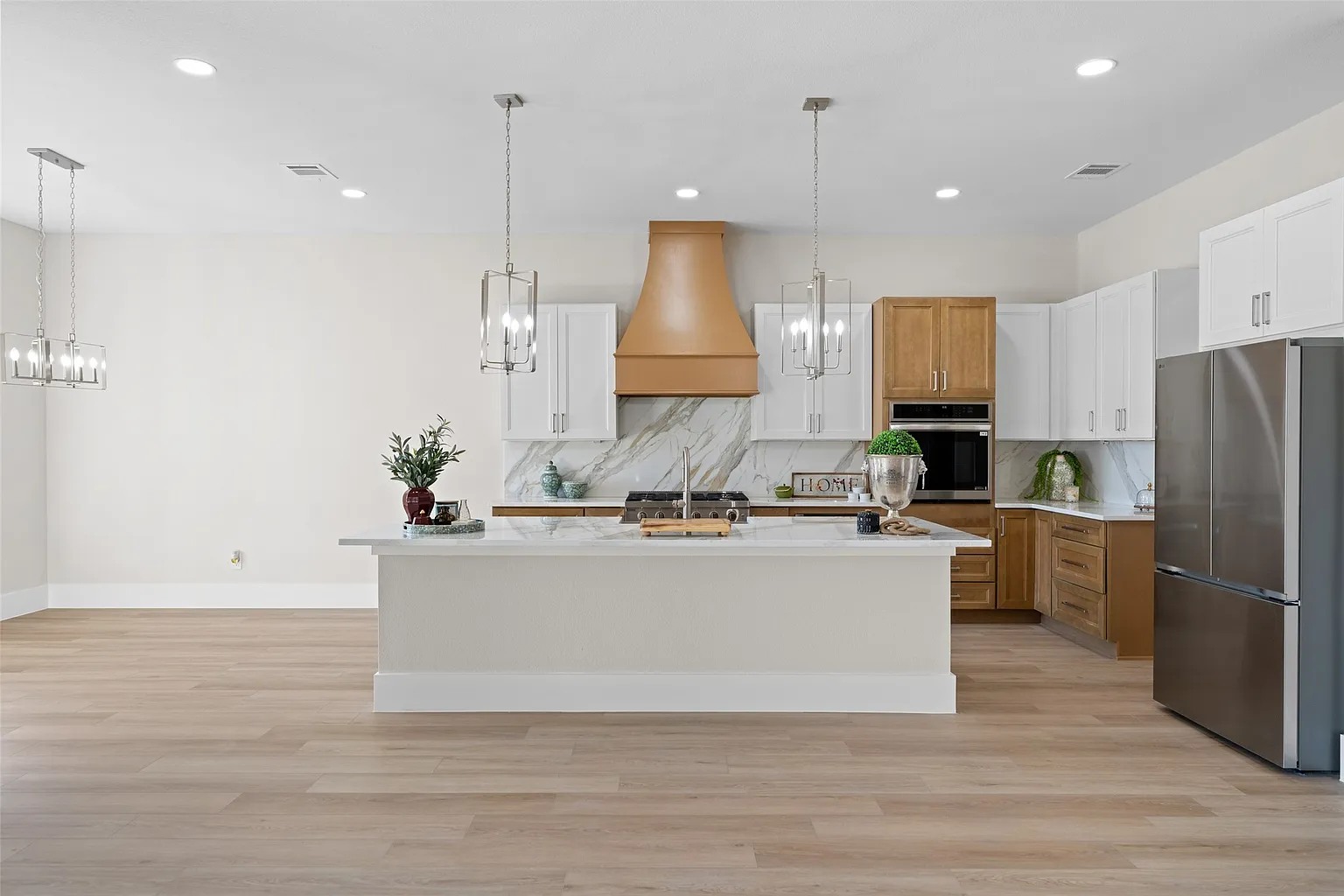
When your home was built, the design center offered a menu: three cabinet door styles, a handful of quartz colors, two or three backsplash tiles. Those were allowances: pre-negotiated products the builder could install at volume. True custom is a different exercise entirely: a cabinet shop building a hood surround to your exact ceiling height, a stone yard where you tag the actual slab, a lighting plan drawn around how your family uses the room.
The clearest proof that new builds get remodeled is a real project. Our builder-home kitchen upgrade in the Lakes of Frisco took a new production home whose owners replaced the allowance-grade kitchen with a custom wood hood, a marble waterfall island, and upgraded finishes throughout: $85,000 on a fixed-price contract, finished in 8 weeks. The house was practically new; the kitchen simply wasn’t theirs. The same playbook applies street for street here, which is why kitchen remodeling in Prosper is dominated by upgrade work rather than gut jobs.

A production builder picks finishes that have to work for a thousand buyers. You only have to please one family, and because the bones are new, every dollar of a finish-out goes into what you actually see and touch.— May N. · Co-Founder, UHS Remodeling
§ 03What do Prosper homeowners upgrade first?
Owners in Prosper’s newer communities ask for the same handful of projects, in roughly the same order. Media walls and fireplace feature walls top the list: a framed, paneled wall with hidden wiring turns a builder’s blank family room into the room the house was bought for. Primary closet build-outs come next: production closets ship with a single rod and shelf, and a full build-out with drawers, an island, and lighting changes daily life more per dollar than almost any other project.
Outdoor living is the Prosper signature. This is a town whose best-known amenity is the 5-acre Crystal Lagoon at Windsong Ranch (outdoor lifestyle is part of why people move here), so covered patio conversions, outdoor kitchens, and pool-adjacent living spaces are heavily requested, especially on the larger lots in Whitley Place, Whispering Farms, and Gentle Creek Estates. Garage upgrades round out the list: storage systems, upgraded flooring, and gym or workshop conversions that reclaim the third bay.
Primary bathrooms deserve their own mention. Builder baths in 2010s-era homes usually pair a garden tub with a framed shower and standard counters. Converting that footprint to a wet room or a curbless shower with a freestanding tub is one of the most requested Prosper bathroom remodeling projects in homes under fifteen years old.
§ 04What does customizing a new construction home in Prosper cost in 2026?
Budgets depend on scope, but 2026 pricing across DFW falls into consistent ranges. These figures reflect fixed-price contracts, so the number you sign is the number you pay:
| Project | 2026 investment range | What it typically covers |
|---|---|---|
| Kitchen upgrade (builder-grade to custom) | $25,000–$95,000 | Custom hood, island rework, slab counters, lighting, appliances |
| Primary bathroom upgrade | $8,000–$60,000 | Curbless shower, freestanding tub, tile, vanities |
| Whole-home finish-out | $95,000–$350,000 | Flooring, trim, built-ins, media walls, paint throughout |
| Addition (outdoor living room, casita, garage expansion) | $120,000–$400,000 | Foundation, framing, roof tie-in, finished interior space |
Two notes on those ranges. Most nearly-new customization lands in the lower half of each range because the infrastructure is already sound; you are paying for finishes, not repairs. And projects stack well: owners commonly sequence a kitchen one year and outdoor living the next. The DFW remodeling cost study breaks down what drives each range, and our kitchen remodel cost breakdown for DFW shows where the money goes line by line.
§ 05Do you need a Town of Prosper permit for a finish-out remodel?
Often, yes. Note that it is the Town of Prosper, not a city. Permits and inspections run through the Building Inspections Division, part of the Town’s Development Services Department, using the online Citizen Self-Service (CSS) Portal. The offices sit at 250 W. First Street, and the division can be reached at 972-346-3502 or permits@prospertx.gov.
The general rule: purely cosmetic work (paint, or closet systems that never touch wiring) typically doesn’t trigger a permit, while anything involving framing, electrical, plumbing, or gas usually does. Media walls with new circuits, outdoor kitchens with gas lines, and bathroom reconfigurations all land in permit territory. One quirk worth knowing: Prosper straddles Collin County and Denton County, but inside town limits your permits go through the Town either way. On any home remodeling project in Prosper we handle the permit filings and inspection scheduling; if you’re planning DIY work instead, confirm requirements with the Building Inspections Division before you open a wall.
The Prosper Finish-Out Checklist
§ 06Should you customize your home, move up, or build custom?
Run the math on all three. Prosper’s move-up market runs roughly $500K to $1M+, and moving costs real money: commissions, closing costs, and often trading a lower mortgage rate for a higher one. Building fully custom on acreage is a multi-year path that mostly makes sense in the estate segment. For most families in master-planned communities, a targeted finish-out gets the house 90% of the way to custom while keeping the Prosper ISD schools, the neighborhood, and the amenities they moved here for. Prosper ISD isn’t just the school district, either. It’s the town’s largest employer with more than 3,300 employees, and its stadium complex that opened in 2019 is a community landmark in its own right. Those roots are worth something when you’re weighing a move.
Where the existing footprint genuinely can’t deliver (a casita for parents, a larger game room, an enclosed outdoor room), home additions in Prosper extend the house rather than abandoning it. Either way, the decision framework is the same: price the gap between the house you have and the house you want, then compare it honestly to the full cost of moving. In a town this new, that gap is usually smaller than owners expect, and it closes in weeks, not years.
§ Q&AFrequently asked questions.
New home, not quite yours? Let us make it custom.
Fully insured · 500+ verified five-star reviews · fixed-price contracts · 1-year workmanship warranty.
May N.
Co-Founder and design lead at UHS Remodeling, a Plano-based DFW design-build firm. She has helped guide kitchen, bath, and whole-home projects across the metroplex since 2014.
UHS Remodeling brings over a decade of experience to remodeling across 21 DFW communities, on fixed-price contracts backed by a 1-year workmanship warranty.