


7 Reasons to Hire a Professional Kitchen Remodeling Company
Seven reasons the professional route usually costs a Plano homeowner less than doing it yourself, from permits to warranty coverage. Plus the short checklist for telling one kitchen remodeling company from another before you sign.
Hiring a professional kitchen remodeling company is the surest path to a Plano kitchen that finishes on time and on budget, and the reason has less to do with raw skill than with everything stacked around it: permits, inspections, deliveries, and trades that have to arrive in the right order. UHS Remodeling works across Plano and the wider DFW area, and the question that decides most kitchens is not whether a homeowner could do the work. It is whether they can run the job around a day job. Here are the seven reasons the professional route usually costs less than doing it yourself, and how to tell one company from another before you sign.
Hire the pro once the job touches plumbing, electrical or structure.
A professional kitchen remodeling company carries the experience, the design work, the permits, the schedule, the finish work, the problem solving and the workmanship coverage that a DIY kitchen has no equivalent for. DIY suits small cosmetic updates. On anything structural or mechanical, mistakes and rework can double the budget, and your own labor carries no coverage.
1. Expertise and Experience
A professional kitchen remodeling company brings years of specialized experience to your project, and most of that value shows up before demolition rather than after. A crew that has opened enough walls already knows which ones are load-bearing, which vent stacks cannot move, and where outdated plumbing will fight the cabinet run you have drawn. They solve those problems on paper, where a change costs an hour, instead of on site, where it costs a week. Experience is not a personality trait here. It is a catalog of failure modes somebody else has already paid for.
UHS Remodeling’s team averages 10+ years of kitchen-specific renovation work across Plano and DFW homes, which is the difference between a crew guessing at your house and one that has already met it. For the full scope of how those projects are run, see our kitchen remodeling in Plano, TX page.
2. Design Vision
Good kitchen design is not cabinet shopping. It is deciding how people move through the room, where prep, cooking and cleanup sit relative to each other, and which materials will still look right after a decade of daily use. Those decisions are hard to reverse once the cabinets are ordered and the counters are templated.
A professional kitchen remodeling company turns a folder of saved photos into a plan that fits your actual space, budget and habits. That also means being told when the island you want will block the dishwasher door, and being told during design rather than during installation.
I would rather argue about a layout for another week than watch a family live around an island that was placed to look good in a photograph. Show me how you cook and I will show you where the kitchen wants to go.

3. Permits and Code Compliance
Most kitchen renovations touch electrical, plumbing or structure, and that means building permits and inspections rather than a quiet weekend of work. The inspection is not a formality. It is the point where undersized wiring, a missing shutoff or an unsupported header stops being a private detail and starts being a condition of living in the house.
A contractor who works in Plano regularly pulls the necessary permits as part of the project and books the inspections around the trades. A homeowner doing it alone carries both jobs, and DIY mistakes can lead to failed inspections and expensive fixes down the road, sometimes after the wall is already tiled over. Permit timing shapes the calendar too: rough-in inspections have to clear before anything gets closed up, so the schedule gets built around the inspector rather than around the crew.
Not sure which of these applies to your house? A short conversation settles it faster than any calculator.
4. Project Management
Keeping a renovation on track means sequencing tradespeople, chasing material deliveries, booking inspections and absorbing the surprises without losing momentum. Cabinets cannot land before the drywall is finished. Countertops cannot be templated before the cabinets are set. Miss one handoff and the next three slide with it.
It is a full-time job, and an experienced contractor is far better equipped to carry it than a homeowner working around their own day job. That is usually the real reason a DIY kitchen stretches out. Not the work. The calendar.
The hard part of a kitchen remodel is not the tile. It is making sure the tile setter, the plumber and the inspector all arrive on the day the schedule says they will.
5. Craft and Execution
Tearing out an old kitchen is blunt work. Installing the new one is not. Cabinet fronts that sit flush, doors that line up across a run, trim that reads crisp at every joint, drywall that stays flat under raking light, tile that meets the counter without a fat joint: those details are the line between amateur work and a finished kitchen, and none of them forgive a first attempt.
That is where professional craftsmanship earns its cost. Finish work is also the first thing a visitor reads in a room, long before anyone mentions what the project cost. Ask a crew how they handle an out-of-level floor under a run of cabinets, and you learn quickly whether finish work is a craft to them or an afterthought.

6. Troubleshooting and Fixes
Careful planning does not prevent surprises. It shortens them. Rot under the dishwasher, walls that turn out to be out of square, a backordered cabinet door: each one is a decision that has to be made the same day it appears, usually with a crew standing in the room.
A seasoned kitchen remodeling company already has the backup plans drawn. A second supplier for the part, a rework order for the wall, a resequenced week so the crew keeps moving while the missing piece ships. A homeowner making that call for the first time can lose weeks over a single item. What you are paying for is not the absence of problems. It is a shorter distance between the problem and the decision.
7. Warranty Coverage
Reputable kitchen remodeling companies stand by their work long after the last coat of paint dries, and the coverage is worth reading closely before you sign anything. Ask what is covered, for how long, and whether it includes the labor or only the materials the manufacturer already stands behind.
DIY work has no equivalent. There is no coverage on your own labor or workmanship, so a cabinet run that sags or a tile floor that cracks is yours to redo at your own cost. That asymmetry almost never appears in a DIY budget, and it is the line that most often turns the cheaper project into the more expensive one.
Tell us what you are planning. We will walk your house, tell you what is actually possible, and put a real number on it before you commit to anything.
Or read the numbers first: kitchen remodeling in Plano, TX.
DIY vs. Professional Kitchen Remodeling
DIY kitchen remodeling can work for small cosmetic updates. Paint, hardware and a light fixture do not need a contract. Anything involving plumbing, electrical or structural changes is a different category, and the comparison below is where the two paths separate.
- Timeline. DIY work often stretches over months around a day job. Professional projects are typically completed in 6 to 12 weeks.
- Cost risk. Mistakes and rework can double the budget. Fixed quotes limit surprise costs.
- Permits. The homeowner must pull and manage permits alone. The contractor handles permits and inspections as part of the job.
- Warranty. DIY carries no coverage on labor or workmanship. Professional work typically covers materials and labor.
Kitchen renovation has a long history as a home improvement project, and that general background on its scope helps explain why it consistently ranks among the most complex and highest-value updates a homeowner can make.
The honest way to read that list is as a question about risk, not ability. A homeowner with time, patience and a cosmetic scope can do very well. A homeowner with a hard move-in date and a wall coming down is buying schedule certainty, and a contract, a fixed quote and a warranty are what that is made of.
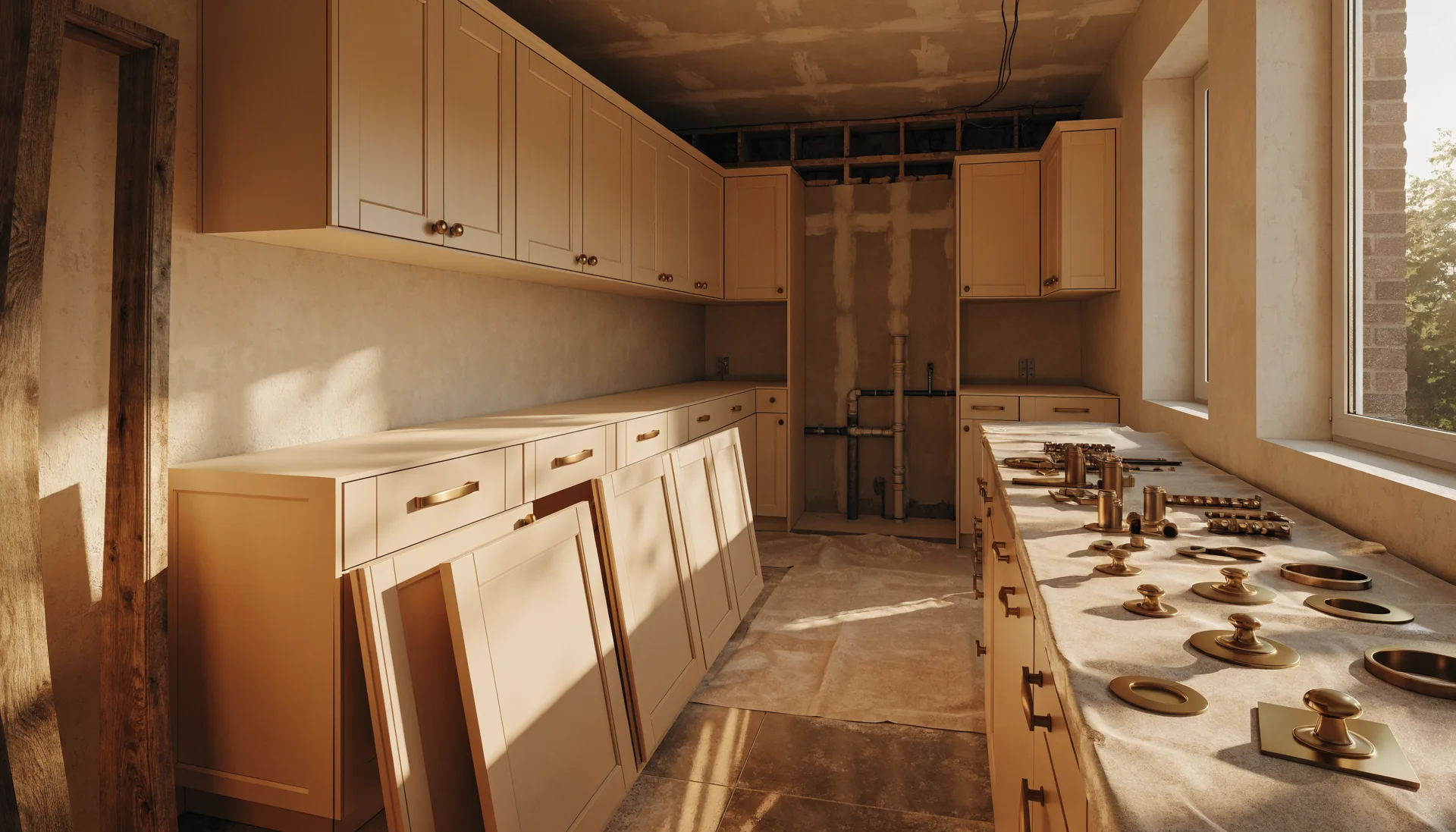
How to Choose the Right Kitchen Remodeling Company
Vetting a kitchen remodeling company is a short sequence, and each step narrows the field for the next one.
Check the license and the insurance
Ask for a current contractor license and confirm the insurance coverage behind it, including worker’s compensation. It is a paperwork question, and a company that stalls on paperwork has answered it.
Read reviews nobody handed you
Look at third-party sites like Google rather than the testimonials a company picked for its own website. The pattern across many reviews tells you more than any single story.
Walk a finished project in person
Ask to see a recently completed kitchen. Photographs flatter a room; a countertop seam and a cabinet reveal do not.
Pin down the communication
Confirm your lead contact and how often you will get updates, then walk through their project management process and how mid-project changes get priced and approved.
Get every promise in writing
Check what the initial quote includes versus what gets billed later, and put the timeline and the payment terms in the contract rather than in the conversation.
The mistakes that cost Plano homeowners the most are not taste mistakes. They are vetting mistakes, and the same few repeat:
Hiring the first contractor who says yes
Skipping due diligence because someone happened to be available this month is how most bad projects begin.
Treating the low bid as the best bid
A low-ball number can mean missing insurance, cut corners or unlicensed subcontractors, and you hold the bill long after that crew has moved on.
Trusting handpicked testimonials
Reviews a company chose to show you are marketing. Reviews it cannot edit are evidence.
Leaving the change process undefined
Mid-project changes are close to inevitable. Settling how they get priced afterward means settling it at the moment you are least able to walk away.
Taking on plumbing, electrical or structure yourself
These are the scopes where a mistake leads to failed inspections and expensive fixes rather than a lesson learned.
A deeper dive on the most important details to check is the surest way to find a remodeling partner you can trust with your biggest investment. When you are ready to hold that checklist up against a real proposal, our Plano kitchen remodeling team will walk the space, price the actual scope and put the schedule in writing. The difference you are paying for is the one between a house in disarray for months on end and a process that respects your time and your budget.
Questions we get
How much does it cost to hire a kitchen remodeling company?
In Plano, a professional kitchen remodel starts around $15,000 for a modest update in a smaller home, with most projects falling between $30,000 and $90,000 depending on the size of the space and the scope of the work. While DIY might look like a cheaper route, making major home renovations without the right skills often means paying twice to get the job done right.
What should you not do in a kitchen remodel?
The biggest mistake is hiring the first contractor who says yes without doing your due diligence. That low-ball bid might mean they lack insurance, cut corners, or rely on unlicensed subcontractors, all of which can leave you holding the bill long after they have moved on. Vet them like you would any long-term investment.
What are the steps in a kitchen remodel?
The basic flow is design and material selection, demolition and prep, plumbing and electrical rough-in, drywall and flooring, cabinet and countertop installation, then finishing touches like trim, paint and hardware. The full start to finish remodeling process takes about 6 to 10 weeks for most kitchens, though custom work can run longer.
What is the best time of year for a kitchen remodel?
Late fall through early spring is the contractor slow season, so you are more likely to land your preferred schedule and lead times may be shorter. Summer is peak time for home renovations, so expect longer waits for materials and subcontractors to be booked out further in advance.
How long does a full kitchen remodel take?
From signing the contract to the final punch list, expect a full kitchen remodel to take 8 to 12 weeks on average. Smaller cosmetic refreshes or a budget kitchen remodel that keeps the existing footprint might wrap up in as few as 6 weeks, while larger structural changes or bespoke orders can take 12 to 16 weeks.
Do I need a permit to remodel a kitchen in Plano?
Most kitchen renovations involve electrical, plumbing or structural work, and that work requires building permits and inspections so it can be checked against current safety codes. A contractor pulls the permits and books the inspections as part of the project. A homeowner going it alone carries that job too, and a failed inspection can mean opening up finished work to correct it.
Is DIY kitchen remodeling ever the right call?
For small cosmetic updates, yes. Paint, hardware and light fixtures are reasonable weekend work. Once the project reaches plumbing, electrical or structural changes, a professional company is the safer choice, because mistakes and rework can double the budget and DIY labor carries no coverage on workmanship.
Seven things separate a professional kitchen remodel from a DIY one, and only one of them is skill with tools. The rest is planning, permits, sequencing and someone who still owns the outcome after the last coat of paint dries. Check the license and insurance, read reviews the company did not pick, walk a finished job, and get every promise in writing.
Related from the journal


Get your kitchen scope priced before you commit in Plano and across DFW.
Fully insured · 500+ client reviews · fixed-price contracts · 1-year workmanship warranty.
Prefer to talk? (469) 850-7087 · or use the contact page.