
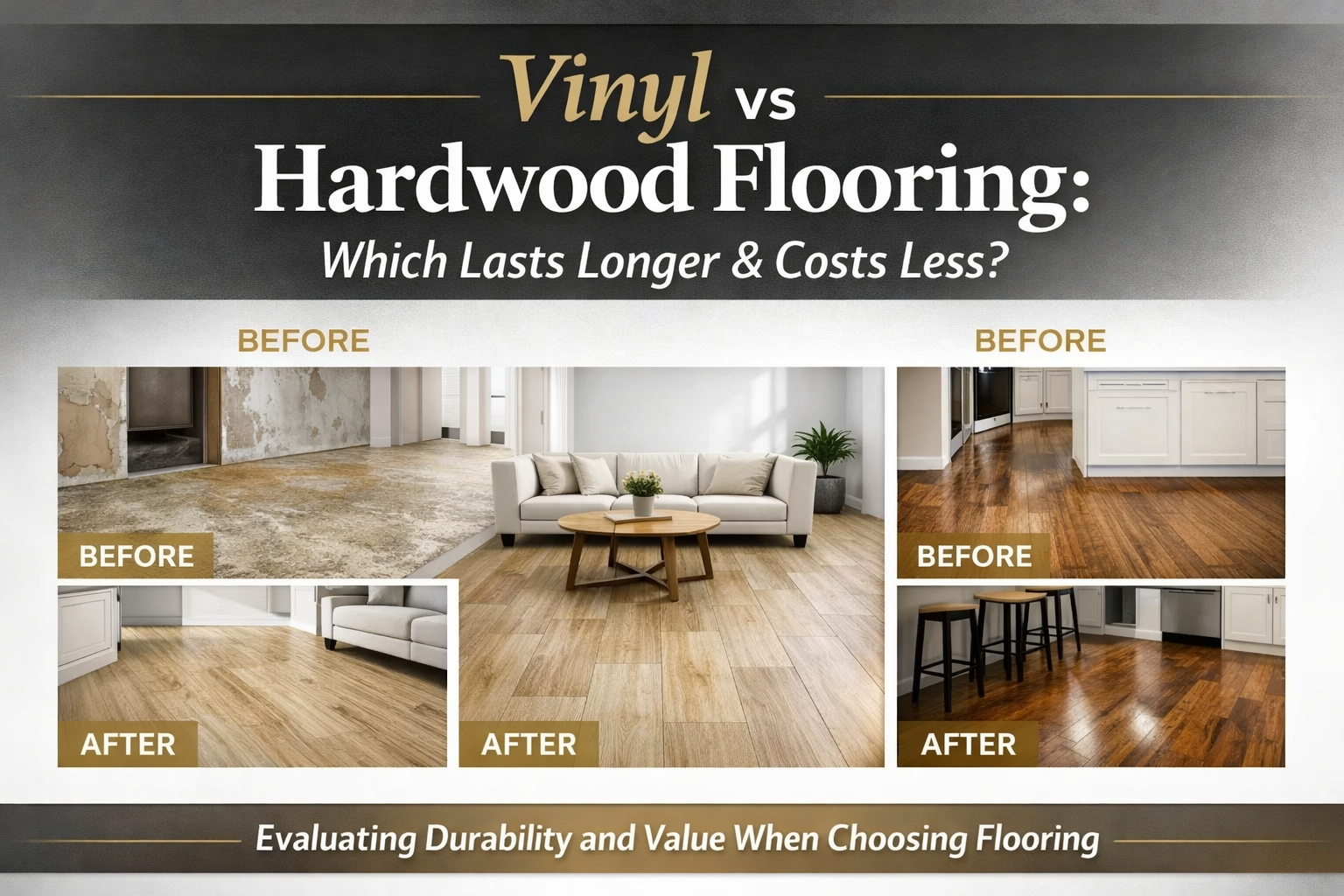
Vinyl vs Hardwood Flooring Cost and Durability: Which Option Saves You More Long-Term?
Vinyl runs $2 to $7 a square foot before installation and handles water; hardwood runs $8 to $12 installed and lasts 20 to 50 years. Here is how the two compare on cost, durability, air quality, and who should be laying the floor.
Vinyl or hardwood is one of the bigger decisions in a renovation, and the wrong call costs you twice: once in a floor that wears out early, and again in the repair or replacement that follows. Both have a real case. Luxury vinyl plank, or LVP, handles water and costs less up front. Hardwood costs more, lasts longer, and holds its value when you sell. At UHS Remodeling we help Plano homeowners weigh cost, performance, and long-term value on this exact choice, and the answer is rarely the same in every room of the house. If you are upgrading for resale, or you want a floor that stands up to a busy household, here is how the two compare before you spend anything.
Vinyl for wet rooms and tight budgets. Hardwood for lifespan and resale.
Luxury vinyl plank costs $2 to $7 per square foot plus $2 to $5 to install and shrugs off moisture, which makes it the pick for kitchens and bathrooms. Hardwood costs $8 to $12 installed, lasts 20 to 50 years, and adds more at resale; engineered hardwood splits the difference at $6 to $10. Whichever you choose, the installation decides how long it lasts.
What decides flooring cost and durability
The label on a box of flooring tells you less than the room it is going into. Homeowners tend to underestimate how much moisture and daily use decide how long a floor holds up; the same plank behaves very differently in a dry bedroom and a wet bathroom. Five things do most of the deciding.
- Material type. Hardwood is real wood, with the grain and warmth that come with it. Vinyl is a synthetic product engineered to resist wear.
- Moisture exposure. Kitchens and bathrooms see water every day, and water is the thing wood reacts to.
- Foot traffic. Entries, hallways, and family rooms need scratch resistance and a finish that is easy to keep clean.
- Installation quality. A poor install raises the long-term durability and maintenance cost of any floor, no matter what it is made of.
- Cost per square foot. Prices vary a long way with the material and with the labor it takes to lay it.
Notice that only one of those five is the price. The other four decide whether the price you paid was money well spent, and three of them are set by the house and how you live in it, not by the store.
If you want to see the wider field before narrowing it to these two, our guide to the best flooring options covers the alternatives.
Here is the order we work through those factors with a homeowner. It is also the order the rest of this article follows.
Find the water
Walk the house and list the rooms that get wet. Kitchens and bathrooms lean vinyl, because hardwood can warp or swell when it is exposed to water unless it is properly sealed and maintained.
Count the traffic
Entries, hallways, and family rooms need scratch resistance and low upkeep. Vinyl and hardwood both get there, but differently: vinyl by resisting the scratch, hardwood by being refinished later.
Price it installed
Compare the installed number per square foot, not the price on the box. Vinyl’s low material cost picks up another $2 to $5 in installation before it is a floor.
Decide who lays it
Installation quality moves the durability and maintenance cost of any floor more than the material does, so decide early whether this is a job you install or a job you hire out.
Vinyl vs hardwood: cost per square foot
These are the numbers we quote, per square foot, and what each one buys you.
Luxury vinyl plank (LVP)
When the budget is tight, luxury vinyl usually wins the comparison on price alone. Material typically runs $2 to $7 per square foot, and installation adds another $2 to $5 on top. That installed number is the one to carry into the comparison, because it is the one you actually pay.
- Water-resistant, which makes it the default for high-moisture rooms
- Lower upfront investment
- Low maintenance
Low maintenance is the quieter advantage. Vinyl does not need the sealing and upkeep that keeps wood healthy in a room that gets wet, which is why it ends up in the kitchens and bathrooms of so many houses that have hardwood everywhere else.
Hardwood
Hardwood delivers the classic look and strong resale value, and you pay for both. Expect $8 to $12 per square foot installed. What that buys is a floor that gets refinished rather than replaced, which is how hardwood reaches a lifespan of 20 to 50 years, and it is why buyers who prefer real wood value it when the house goes on the market.
- Made from real wood
- Long lifespan, 20 to 50 years
- Higher installation cost
The catch is moisture. Solid wood is more sensitive to water than vinyl, and a hardwood floor in a room that gets wet will warp or swell unless it is properly sealed and maintained. Keep it in the dry rooms and it earns its price; put it beside a tub and you are paying the premium to watch it fail.
Engineered hardwood
Engineered hardwood sits between the two. A top layer of real wood gives you the look, and it handles moisture better than solid wood at a moderate price: engineered flooring typically runs $6 to $10 per square foot. How long it lasts depends on the thickness of that top wood layer and on how it is maintained, which is why we call it the middle-ground option rather than a cheaper solid floor.
DIY flooring: what homeowners try first
Plenty of homeowners try to install flooring themselves to save money, especially with LVP products marketed as “easy install.” The usual attempts look like this:
- Click-lock vinyl plank systems
- Glue-down vinyl installations
- Floating engineered hardwood floors
- Basic floor board replacements
The pattern we see is that the product is sold on how easily it locks together, and nothing on the box says what the subfloor underneath it needs to look like first.
Some homeowners lean on online tutorials, or on guides like our rundown of flooring tools, and take the whole job on themselves. The tools are the easy part. What the tutorials tend to skip is everything that has to happen before the first plank goes down.
Not sure which of these applies to your house? A short conversation settles it faster than any calculator.
Why DIY flooring installation fails
DIY looks cost-effective until the bill for the second attempt arrives. Flooring installation needs precision, subfloor preparation, and moisture control, and those three are exactly where a first-time install falls short. The material rarely fails. The prep underneath it does.
Uneven subfloors
Gaps open between planks and the floor wears out early wherever it rocks.
Improper moisture barriers
Planks warp, or mold gets a start underneath where nobody can see it.
Poor alignment
Crooked seams and a finish that looks sloppy from the doorway, and stays that way.
Incorrect expansion gaps
The floor buckles when it moves and has nowhere to go.
None of these show up on the day the floor goes in. They show up later, once the material has moved with the house, and by then the fix costs more than hiring the install would have at the start.
Many homeowners end up paying more to fix these mistakes than they would have paid to hire the job out at the start. And hiring does not end the risk: our piece on contractor mistakes covers the shortcuts to watch for on someone else’s crew too.
The biggest factor is not the material. It is the installation. Poor workmanship can ruin even the best flooring.
Air quality and material safety
Flooring affects the air inside the house and the footprint outside it. According to the U.S. Environmental Protection Agency, some flooring products emit volatile organic compounds, or VOCs, that affect health. The EPA indoor air quality guide explains how synthetic materials like vinyl can release emissions when low-quality products are used, which is the argument for asking about low-VOC options before you buy.
Research from academic institutions points the other way for wood: natural wood products can offer better sustainability when they are sourced responsibly. Vinyl, as a synthetic material, may carry environmental concerns around production and disposal. The National Wood Flooring Association lands on the same point we do about hardwood, that proper installation and maintenance are what deliver long-term performance out of it.
I ask where the water is before I ask what the floor should look like. The rooms that get wet pick the material for me, and the rest of the house can have the wood if that is what the family wants.
When you need professional flooring services
Some jobs should not be a weekend project, and the signs are not subtle. Bring in a professional, UHS Remodeling or anyone else you trust, when you are looking at any of these:
- Large areas, anything over 500 square feet
- Subfloor damage or an uneven surface
- Installation in kitchens and bathrooms
- High-end engineered hardwood or solid wood
- A floor you expect to hold its value and pay you back at resale
Each of those raises the cost of a mistake. A big area repeats a small alignment error across every row. A damaged subfloor has to be found and fixed before anything goes on top of it. Wet rooms need the moisture barrier done right the first time. And expensive material is expensive to waste.
If the floor is one piece of a bigger project, start with renovation planning so the flooring lines up with the overall design, and see how flooring fits into a full home remodeling project in Plano before you order material.
Tell us what you are planning. We will walk your house, tell you what is actually possible, and put a real number on it before you commit to anything.
Or read the numbers first: home remodeling in Plano.
What UHS Remodeling brings to a flooring job
Choosing the contractor matters as much as choosing the floor. We bring craftsmanship, experience, and local knowledge to the work, which in practice means:
- Accurate cost estimates per square foot
- Installation for vinyl, hardwood, and engineered flooring
- Straight guidance on luxury vinyl versus engineered hardwood
- A focus on durability in busy households
- Work completed across Texas, including Dallas, Plano, Frisco, and Allen
The guidance line matters more than it looks. A lot of flooring conversations start with the material already chosen, and the useful question is whether it belongs in the room it is headed for. Sometimes the answer is yes. Sometimes the answer saves a homeowner from putting solid wood in a bathroom.
For the before-and-after side of it, browse our remodeling ideas.
The right investment: vinyl or hardwood
The right choice depends on your lifestyle, your budget, and how long you plan to stay. Vinyl brings affordability and moisture resistance. Hardwood brings a look nothing synthetic reproduces and value that holds at resale. Often the answer is both: vinyl where the water is, wood where the family lives. If resale is the reason for the project, the hardwood premium is the one buyers recognize. If a busy household is the reason, vinyl in the wet rooms is where the durability argument gets won.
Whichever way you go, the material is not the biggest factor. The installation is, and poor workmanship can ruin even the best flooring. If you want a floor that lasts, looks the part, and adds value to the house, contact UHS Remodeling to schedule a flooring consultation and get guidance for your home specifically. If the floor is part of a larger scope, our home remodeling in Plano page shows how we run the whole job.
UHS Remodeling serves North Texas: based in Plano with dedicated crews across Plano, Frisco, Allen, Dallas, Highland Park, and Prosper, and 9 more DFW cities. See the 2026 DFW Home Remodeling cost guide.
Questions we get
Is luxury vinyl flooring better than hardwood for durability?
Luxury vinyl planks LVP are highly resistant to scratches, moisture, and wear, making them ideal for high traffic areas. However, hardwood offers long-term durability through refinishing, giving it a longer lifespan despite being more sensitive to moisture.
What is the cost difference between vinyl and hardwood flooring?
Vinyl typically ranges from $2-$7 per square foot, while hardwood can reach $12 per square foot installed. Engineered hardwood falls in between. Vinyl is cheaper upfront, but hardwood often provides better resale value over time.
Which flooring is best for kitchens and bathrooms?
Vinyl is the better option for kitchens bathrooms due to its resistance to high moisture. Hardwood can warp or swell if exposed to water, making it less suitable unless properly sealed and maintained.
Does engineered hardwood last as long as solid hardwood?
Engineered hardwood offers good durability but typically doesn’t last as long as solid hardwood. Its lifespan depends on the thickness of the top wood layer and maintenance, making it a middle-ground option.
Is vinyl flooring environmentally friendly?
Vinyl is a synthetic material and may have environmental concerns related to production and disposal. However, low-VOC options are available. Hardwood sourced responsibly offers better sustainability and environmental impact benefits.
Can DIY flooring installation save money?
DIY can reduce upfront costs, but mistakes often lead to expensive repairs. Improper installation affects durability and maintenance, making professional installation a safer long-term investment.
Which flooring adds more home value?
Hardwood flooring adds more resale value due to its classic look and natural wood appeal. Buyers often prefer real wood, making it a strong investment for long-term property value.
Put vinyl where the water is and hardwood where the value is, price both installed rather than by the box, and hire the install once the job passes 500 square feet, touches a kitchen or bathroom, or sits on a damaged subfloor. The material rarely fails. The prep underneath it does.
Related from the journal
Get the floor priced for the rooms it is going into vinyl, hardwood, or engineered, installed once.
Fully insured · 500+ client reviews · fixed-price contracts · 1-year workmanship warranty.
Prefer to talk? (469) 850-7087 · or use the contact page.